Passa al contenuto principale

Autore: marketing.nvalue

EcoVadis ESG progress

A silver medal is only the beginning

In February this year, Nvalue earned an EcoVadis Silver medal. We’re proud of it, and prouder still of what earning it actually required.

Sustainability commitments are cheap to write and expensive to verify. A pledge lives in a policy document, but a rating asks for proof of fair treatment of workers, of an honest supply chain, of an environmental footprint you can measure rather than estimate. If businesses are going to reduce harm and improve the lives of the people connected to them, someone impartial has to check the work.

The bar is constantly rising

EcoVadis now rates more than 175,000 companies across over 180 countries, making it the largest business sustainability rating network in the world. The scale has made it become a procurement shorthand, and when a company asks a supplier for its EcoVadis score, it isn’t curiosity, it’s risk management, an attempt to avoid onboarding risk it can’t otherwise see. A strong score used to be a differentiator, but increasingly, it’s the price of admission.

The room is also getting harder to enter. With EcoVadis being a percentile-based medal system, a Silver medal isn’t measured against a fixed bar, it’s measured against everyone else in the network, and everyone else is improving too. Between July 2025 and January 2026 alone, the score needed for Silver rose from 68 to 72 out of 100, which is a four-point jump in just six months. Remaining stagnant, in a system like that, amounts to falling behind.

This is part of why we at Nvalue rate EcoVadis so highly. Its credibility comes from the fact that it refuses to let companies stand still, rewarding continuous, demonstrable improvement rather than a single good year. Simply holding on to a Silver medal means carrying on getting better just to keep pace, and reaching Gold asks for more again; improving faster than your peers, finding more innovative ways to cut emissions and look after the people connected to you, or investing more decisively in your sustainability transition.

The data backs this up in an unglamorous but telling way. EcoVadis’s own 2026 index found that companies new to the network score an average of 51.5, while companies with ten or more years of engagement average 63.2. Sustainability performance compounds over time, and it rewards the companies that treat it as an ongoing discipline rather than a form filled out before a tender deadline.
The turbulent sustainability environment

The GHG Protocol, the accounting rulebook that almost every other climate framework leans on, is going through its biggest overhaul in more than a decade. Its scope 2 guidance is under active revision, with a second public consultation expected later in 2026 and a final standard due in 2027. Its scope 3 standard is tightening too, and an early-2026 progress update proposed that companies cover at least 95% of required scope 3 emissions, pushing companies away from generic spend-based estimates and toward real supplier data. The definition of “good enough” carbon accounting is moving upward.

The Science Based Targets initiative followed close behind. Its Corporate Net-Zero Standard, version 2.0, published in June 2026, is its most significant revision since the standard launched in 2021, and more than 11,000 companies already hold validated targets under the previous version. Scope 1 and scope 2 now have to be targeted separately rather than bundled together, scope 2 claims face a higher quality bar, and larger companies will need a formal climate transition plan backed by third-party assurance. The new standard becomes mandatory for new submissions from January 2028, which sounds distant until you account for how long it actually takes to build a clean scope 1, 2 and 3 inventory from scratch.

The CSRD, meanwhile, has moved the opposite way. The EU’s Omnibus reform, in force since March 2026, raised the reporting thresholds so sharply that somewhere between 80 and 90 percent of companies originally expected to report under CSRD no longer have to. For those companies, it’s tempting to read this as pressure lifting. In practice, it has simply changed shape, because the clients, banks and larger partners who used to expect a CSRD report will still want that information; they’ll simply ask for it directly instead of receiving it through a regulator’s format, and a voluntary standard aimed at smaller companies is already being built to fill that gap.

Together, these three shifts trace a clear line. Carbon accounting is getting stricter, net-zero claims require more evidence behind them, and although fewer companies are legally required to publish any of it, the market keeps expecting to see it.

The gap EcoVadis was built for

EcoVadis was never a regulatory filing. It has always been a market mechanism in which buyers and companies choose, voluntarily, to hold each other to a shared, comparable standard. That is in part, why it becomes more valuable, not less, as mandatory reporting narrows and voluntary expectation widens. Its Environment theme already leans on GHG Protocol-aligned data and its criteria already reward companies with a genuine emissions inventory, published targets, and evidence of follow-through – the same things SBTi 2.0 now expects, and a CSRD report would have contained. Whether or not you’re legally required to report anything at all, an EcoVadis assessment gives you a structured, internationally recognised way to demonstrate exactly where your sustainability performance stands, with the evidence to back it up.

Nvalue’s Silver medal sits inside a network where, by EcoVadis’s own data, the average company still has real gaps to close, because only 26% maintain a full GHG inventory, and under 20% report scope 3 emissions in either direction. But closing gaps like that isn’t just a scoring exercise, it’s the same work that makes a company more resilient to the next regulatory shift, more attractive to the banks and investors now weighing ESG performance into financing decisions, and more trustworthy to the people who work there.


We are here to help

If you’ve been wondering whether an EcoVadis assessment is worth pursuing for your own organisation, or whether you’re still on solid ground given everything moving around CSRD, SBTi and the GHG Protocol this year, that’s a conversation worth having. We’d be glad to have it with you.

Contact us


Continua a leggere

CO2: dalla compliance al vantaggio competitivo

CO2: dalla compliance al vantaggio competitivo

ETS1, ETS2 e CBAM non sono tre regolamenti indipendenti, ma tre manifestazioni di un unico fenomeno: il costo della CO₂ entra progressivamente in ogni fase della supply chain. Comprenderne l’evoluzione significa trasformare un obbligo normativo in uno strumento di pianificazione strategica.

Per molti anni la gestione delle emissioni è stata affrontata prevalentemente come un tema di conformità normativa. Le imprese hanno imparato a misurare la propria carbon footprint, a produrre inventari emissivi e a soddisfare requisiti regolatori sempre più articolati.

Questa impostazione, oggi, non è più sufficiente.

La vera trasformazione in atto non riguarda soltanto l’introduzione di nuovi obblighi europei, ma il fatto che il carbonio stia assumendo le caratteristiche di una vera variabile economica. Come il prezzo dell’energia, delle materie prime o dei tassi di cambio, anche il costo della CO₂ è destinato a influenzare direttamente la competitività delle imprese.

Per comprenderne gli effetti è necessario cambiare prospettiva.

L’obiettivo non è più limitarsi a costruire un inventario delle emissioni, ma sviluppare un modello di simulazione economica della supply chain sotto vincoli carbonici, capace di descrivere come il costo della CO₂ si propagherà lungo l’intero ciclo produttivo al variare del quadro regolatorio e dei mercati ambientali.

Negli ultimi decenni le imprese hanno imparato a gestire il rischio legato ai prezzi dell’energia, delle materie prime e dei cambi valutari attraverso strumenti di analisi, previsione e copertura finanziaria. Il carbonio sta rapidamente assumendo la stessa natura economica. Il suo prezzo evolve nel tempo, dipende da mercati regolati, influenza direttamente i margini industriali e può essere gestito con strumenti quantitativi. La differenza è che, mentre energia e materie prime vengono normalmente monitorate dai responsabili acquisti o dalla funzione finance, il costo del carbonio attraversa simultaneamente approvvigionamenti, produzione, logistica, investimenti e pianificazione industriale. Per questo motivo richiede un approccio integrato.

L’Europa sta infatti costruendo un sistema nel quale ETS, ETS2 e Carbon Border Adjustment Mechanism (CBAM) non rappresentano strumenti indipendenti, ma tre manifestazioni della stessa logica economica: attribuire progressivamente un prezzo alle emissioni di carbonio nei diversi punti della filiera.

Per comprenderne gli effetti può essere utile immaginare una situazione concreta.

Prendiamo il caso di un’azienda italiana che trasformi l’alluminio. La materia prima consiste in lingotti prodotti in Asia e successivamente importati in Europa.

Il primo elemento di costo nasce già nella fase produttiva. L’alluminio rientra infatti tra i prodotti soggetti al CBAM e il contenuto emissivo incorporato nel lingotto diventa una componente economica destinata a riflettersi sul costo di importazione.

Ma il percorso del carbonio non termina qui.

Per raggiungere l’Europa, il materiale viene trasportato via mare. Anche il trasporto marittimo è ormai interessato dall’estensione del sistema europeo ETS e il costo delle quote acquistate dagli armatori tende progressivamente a riflettersi sul prezzo del trasporto e quindi sul valore della merce movimentata.

Una volta sbarcato nel porto italiano, il materiale viene trasferito allo stabilimento di trasformazione. Se il trasporto avviene su gomma, dal 2028 entrerà progressivamente in gioco anche l’ETS2, destinato ad attribuire un costo alle emissioni associate ai combustibili utilizzati nel trasporto stradale. L’effetto dipenderà dal prezzo futuro della CO₂, ma è ragionevole attendersi un incremento del costo dei carburanti, tra i dieci e i venti centesimi al litro, che si propagherà lungo tutta la logistica distributiva.

All’interno dello stabilimento entrano poi in gioco ulteriori componenti.

L’energia elettrica incorpora già il costo delle quote ETS sostenuto dai produttori. Per quanto riguarda invece il gas naturale, il meccanismo dipende dal profilo dell’impresa: gli impianti soggetti all’EU ETS sostengono direttamente gli obblighi di compliance, mentre quelli esclusi vedranno trasferito il costo dell’ETS2 attraverso il prezzo del combustibile applicato dal fornitore.

Infine, il prodotto finito dovrà raggiungere clienti e distributori, affrontando una nuova fase di trasporto che, ancora una volta, risentirà degli effetti dell’ETS2.

Osservando l’intero percorso emerge un elemento spesso sottovalutato: non esiste più una fase della supply chain realmente neutra rispetto al carbonio.

Cambiano gli strumenti regolatori, cambiano i soggetti che sostengono direttamente gli obblighi di compliance, ma il risultato economico rimane lo stesso. Il costo della CO₂ accompagna il prodotto durante tutto il suo ciclo di vita, dalla produzione della materia prima fino alla consegna al cliente finale.

È proprio qui che la compliance lascia spazio alla strategia.

Una volta ricostruita la supply chain dal punto di vista emissivo — considerando le emissioni dirette, quelle associate ai consumi elettrici e gli hotspot più rilevanti dello Scope 3 — è possibile sovrapporre un secondo livello di analisi: l’evoluzione del costo del carbonio nei diversi punti della filiera.

Prezzo delle quote EU ETS, introduzione dell’ETS2, meccanismi CBAM, intensità emissiva dei materiali, distanze percorse, tecnologie produttive e scenari regolatori possono essere integrati all’interno di un unico modello economico.

La domanda, a questo punto, cambia radicalmente.

Non si tratta più di sapere quanto costa oggi una EUA o un CBAM certificate, ma di comprendere come cambierà la competitività della supply chain al crescere del prezzo della CO₂.

Raggiunti certi livelli di prezzo del carbonio, potrebbe diventare conveniente sostituire un fornitore asiatico con uno localizzato nel Medio Oriente o nel bacino del Mediterraneo, se questo, oltre a tagliare le emissioni legate al trasporto marittimo, riduce contemporaneamente il contenuto emissivo del materiale importato. Oppure potrebbe risultare economicamente preferibile investire in un fuel switch, modificare il mix energetico dello stabilimento o adottare strumenti di copertura finanziaria sui mercati del carbonio.

Non esiste una risposta valida per tutte le imprese.

Esistono però modelli quantitativi che consentono di simulare questi scenari, confrontare filiere alternative e individuare il punto nel quale determinate scelte industriali diventano economicamente preferibili.

È questo il principio sul quale Nvalue ha sviluppato il proprio CO₂ Risk Assessment, uno dei servizi distintivi della divisione Advisory.

È questo il principio sul quale Nvalue ha sviluppato il proprio CO₂ Risk Assessment, uno dei servizi distintivi della divisione Advisory.

Attiva dal 2008 nei mercati ambientali, Nvalue supporta le imprese nella gestione degli strumenti legati alla decarbonizzazione, dai mercati del carbonio alle certificazioni di energia rinnovabile, fino alle strategie di compliance e approvvigionamento energetico. In Italia, Nvalue affianca aziende industriali, importatori e operatori esposti a ETS, ETS2 e CBAM, aiutandoli a comprendere l’impatto economico della regolamentazione climatica e a trasformarlo in decisioni operative, finanziarie e strategiche.

L’obiettivo non è supportare esclusivamente gli adempimenti regolatori, ma costruire un modello dinamico dell’esposizione carbonica della supply chain, integrando dati emissivi, mercati del carbonio, scenari regolatori e valutazioni economico-finanziarie.

In questa prospettiva ETS, ETS2 e CBAM cessano di essere soltanto strumenti di compliance e diventano componenti di un’unica strategia industriale.

Il vantaggio competitivo nasce proprio qui: nella capacità di anticipare gli effetti economici della transizione climatica prima che si manifestino nei conti economici, trasformando il costo della CO₂ da semplice vincolo regolatorio a leva di pianificazione e di decisione.


Contatta Nvalue per valutare l’esposizione della tua supply chain al costo della CO₂ e trasformare ETS, ETS2 e CBAM in strumenti concreti di pianificazione strategica.

Contact us


Continua a leggere

Electrification Action Plan and ETS review

Electrification Action Plan and ETS review

The package at a glance

On 17 July 2026, the European Commission proposed a major overhaul of the EU ETS for Phase 5 (2031–2040). The reform aims to balance industrial competitiveness with the EU’s 90% net emissions reduction target by 2040, while supporting electrification and investment in low-carbon technologies.

  • Still a proposal: Parliament and Council negotiation is expected to run into 2027, and details will move
  • Paired with a target to double electrification’s share of final energy demand
  • Framed as the foundation for the EU’s 2040 target of a 90% net emissions cut
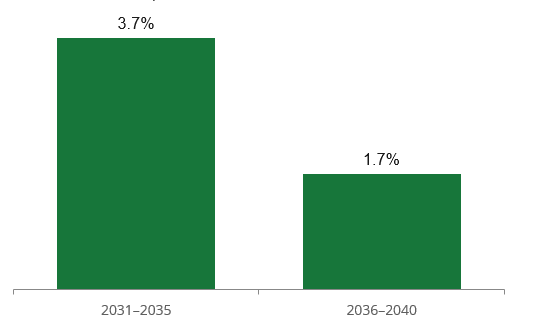
  • 3.7%

    Annual cap reduction factor 2031–2035, down from 4.4%

  • +4 years

    Free allocation extended beyond the current phase-out

  • 12%

    Proposed MSR intake rate (down from 24%)

The cap slows, free allocation persists with new strings attached

Annual cap reduction rate (linear reduction factor)

Compares with a current Fit-for-55 baseline of 4.3% (2024-27) then 4.4% (2028+): a materially more gradual decline that eases near-term scarcity but stretches the path to 2040.

  • Slower cap reduction could ease EUA scarcity after 2030.
  • Free allocation would continue until 2038, four years longer than under Fit-for-55.
  • Companies would need to demonstrate credible decarbonization investments to retain full allocation.
  • Sector benchmarks will continue to determine allocation volumes.

New flexibility mechanisms

  • 1. Carbon removals

    CRCF-certified permanent removals enter the cap via a 250 million allowance increase, ramping to 48 Mt a year by 2040 (an estimated €50bn market). Only BioCCS and DACCS qualify initially, other pathways are excluded for now. Three integration models remain under review: central public purchase, operator-led procurement and surrender, and a one-in-one-out mechanism.
  • 2. Market Stability Reserve

    The MSR is repositioned as a standing strategic reserve rather than a mechanical valve. The automatic invalidation of allowances above the current threshold is being scrapped in favour of retaining them as a stability buffer.

Тhe ETS ecosystem in Phase 5

  • Scope expansion

    Municipal waste incineration is proposed to become a permanent part of the EU ETS from 2028.

  • Industrial Decarbonisation Bank

    A new EU financing mechanism from 2028, directing ETS revenues towards industrial decarbonisation and carbon removals. Its first phase (2028–2031) reserves 400 million EUAs for an Investment Booster paying fixed carbon premia, first-come first-served, with a share reserved for lower-income states.

  • Revenue use

    Channelling is simplified through the Industrial Decarbonisation Fund and the Innovation Fund, with a stated aim of directing industry-linked revenue back to industry.

  • ETS1–ETS2 interaction

    The proposal strengthens coordination between ETS1 and ETS2 to ensure a more coherent carbon pricing framework.

What this means for you

  • 1

    Free allocation isn’t disappearing, conditionality is the new compliance risk to plan around.

  • 2

    Carbon removals are becoming a real compliance lever; early positioning is an advantage, not just a hedge.

  • 3

    The Industrial Decarbonisation Bank and Innovation Fund, create new opportunities to finance electrification, CCS and fuel switching.

  • 4

    If you’re covered by ETS2, watch the ETS1/ETS2 coordination signal closely, it may reshape scope timing.

What should you do next?

Recommended next steps

  • 1

    Map your own free allocation exposure against the proposed conditionality criteria.

  • 2

    Put removals procurement on your 2026–2027 watch list if you’re in a hard-to-abate sector.

  • 3

    Screen planned electrification, CCS, fuel-switching and efficiency projects for potential support through ETS funding mechanisms.

  • 4

    Revisit your plan once Parliament and Council positions emerge.


Questions on how this affects you?

For support and guidance as these proposals develop, we’re here to help you plan!

Contact us


Continua a leggere

Inside Nvalue UK: Nathalie’s hands-on internship experience

Eight weeks ago, Nathalie Esau-Buitrago joined Nvalue as an intern supporting our UK team.

Currently studying Business Management at ESCP Business School, Nathalie brought with her a strong interest in international business, sustainability, and market development. During her internship, she had the opportunity to work closely with the UK team, gaining hands-on experience in business development, sales strategy, and the challenges of establishing Nvalue’s presence in a new market.

From the very beginning, Nathalie approached the experience with curiosity, energy, and a willingness to learn. Her time with us quickly became more than an introduction to carbon markets and sustainable market solutions: it was a dynamic, practical, and confidence-building journey.

In this short interview, Nathalie shares what she learned, what challenged her, and what she will take with her from her time at Nvalue.

1. Why did you choose our company for your internship?

As a business student, I chose Nvalue because it brings together two areas I’m interested in: business strategy and sustainability which is central to how companies operate. Most businesses now have to deal with net zero, emissions, and how they hit their climate targets, and carbon markets are one of the main ways they do that. I wanted to understand what actually sits behind those goals, and tools companies use to meet them.

Nvalue also stood out because it was setting up its UK operation. I’m very interested in business development and sales, and how a company establishes itself in a new market, so joining an emerging UK business gave me insight and exposure to that. A small team also meant working hands-on from the start, which is how I learn best, and it meant the work I did made a real difference.

2. What were your expectations before you started?

Honestly, coming in, I expected to spend a lot of time observing and getting up to speed, especially as carbon markets and sustainable market solutions were very new territories to me. I anticipated taking on two big projects, business development and sales strategy, though I wasn’t exactly sure what that would involve. I thought I’d mostly be supporting other people’s work at first, rather than leading anything myself.

3. Were your expectations met?

My expectations were definitely exceeded. I was able to pick things up quite quickly, largely because I was constantly in the working environment – I had the opportunity to have many conversations, not just with my colleagues but with people I was introduced to/met at conferences, in the coworking space, and elsewhere, who all taught me a lot. My colleagues were also super open and happy to answer my endless questions, which made a huge difference to how fast I learned. On top of that, I was given a lot of independence in my own work. Of course, I was given plenty support and guidance when needed, but it was ultimately up to me to create and lead my own projects, which I really enjoyed.

4. How would you describe your internship experience?

I had an extremely positive experience with Nvalue and couldn’t have asked for a better internship. My manager Lisa and colleague Jack were an amazing team who offered a lot of support and guidance and really encouraged me in my work.

The experience was very dynamic, which is something I really enjoy and look for in a working environment. I was given the opportunity to travel a lot, going to conferences, even on my own, to represent Nvalue and meet new people in the industry. I was also given a lot of independence and trust in my own work where I led two of my own projects in Nvalue’s UK business development and commercial strategy, which I then presented to the directors of the company. That really pushed me outside my comfort zone and helped me grow in confidence.

I also saw first-hand how much work goes into establishing a company in a new market, which I found genuinely interesting and insightful. I found it a very valuable lesson, especially if I ever look to start my own business one day.

5. Did you have the opportunity to apply what you learned during your studies?

Yes, definitely. One thing I spoke about a lot with my colleagues was the importance of intercultural skills in an international workplace like this, which I learnt from one of my modules. In a company that works across different countries, it’s really important to understand and acknowledge other people’s cultures rather than seeing everything through your own cultural lens and that came up constantly in how I worked and communicated with people.

I was also able to apply a lot of my marketing studies to the sales and commercial strategy side of my projects, from thinking about positioning and messaging through to how you approach a new market. Additionally, I was able to directly transfer the skills I picked up from group and research projects at university into the work I did for Nvalue – research, analysing information, and pulling it together into something coherent and usable.

6. What did you enjoy the most during your internship?

What I enjoyed most was how dynamic it was. The travelling, conferences, and constantly meeting new people meant there was always something to learn. I learnt so much not just from my own conversations but also from listening to and observing my colleagues in theirs. Seeing how they built relationships, handled discussions, and turned a conversation into an opportunity was incredibly interesting and informative.

7. Was there any task you found particularly challenging?

Starting my projects from scratch was a little challenging. As I mentioned, this was a completely new area for me, so at first, I felt a little overwhelmed about where to begin but with my colleagues’ guidance, I broke it down into smaller steps, and once I had a clearer structure my confidence grew.

8. What will stay with you from this experience?

I think what will stay with me most is the confidence I’ve gained; I came in knowing close to nothing about carbon markets and sustainable market solutions and left having led and presented my own projects, which is something I’m quite proud of.

9. How did you find working with the team?

I really enjoyed working with the UK team. Both Lisa and Jack are incredibly intelligent and knowledgeable, and they both taught me so much. They were always very willing to offer me guidance and support whenever I needed it and really integrated me into the team. Most importantly, they actually gave me real tasks to do. I think a lot of interns  end up overlooked during their internships, so being trusted with real responsibility made a big difference and made the whole experience so much more rewarding. Although I didn’t spend a lot of time with the rest of the Nvalue team, they were also really welcoming and always willing to offer me their time and knowledge.

10. What are your plans for the future?

Although I’m not entirely sure just yet, this internship has introduced me to an industry I’m really interested in exploring further as it feels like a good fit for me. I’d like to build on what I’ve learned here whether that’s in carbon markets specifically or more broadly in the business development and sustainability space.

11. If you had to describe this experience in three words, what would they be?

Dynamic, challenging and hands-on.


We would like to thank Nathalie for her contribution, curiosity, and positive energy throughout these eight weeks, and we wish her all the very best for the next steps in her university and professional journey.


Continua a leggere

Tennis Europe Summer Cup Girls 14 & Under 2026 Loano 02

Nvalue is proud to sponsor the 2026 Tennis Europe Summer Cup Girls 14 & Under in Loano

Nvalue is pleased to support the 2026 Tennis Europe Summer Cup Girls 14 & Under, taking place in Loano from 29 June to 1 July 2026, with the opening ceremony scheduled for 28 June.

The tournament will take place in Loano, at the tennis facilities managed by ASD Tennis e Sport Educativo Alberto Zizzini, bringing together some of the most promising young female tennis players in Europe. The final stage will see the best national teams from the qualifying rounds compete for the European title and for access to the World Junior Tennis Competition.

The European Summer Cup is one of the key moments in the youth tennis calendar. It is a competition where technical quality, discipline, teamwork and resilience are tested at a formative stage in the athletes’ development. For many young players, events like this represent an important step in an international sporting journey.

Loano continues to confirm its role as an important host location for junior tennis. The town, together with the local tennis association, provides a setting where sport, education and community come together, offering young athletes the opportunity to compete in a professional and welcoming environment.

Nvalue has supported this event over the years, because we believe that long-term value is built through responsibility, commitment and trust. These principles are central to our work in environmental markets and sustainability, and they are equally visible in sport: in preparation, respect for rules, fair competition and the ability to look beyond immediate results.

Supporting young athletes means investing in the future. It means encouraging talent, ambition and international exchange, while contributing to an event that brings together players, coaches, families and local communities around a shared passion.

We are proud to stand alongside the organisers of the Tennis Europe Summer Cup Girls 14 & Under and to contribute to an initiative that combines sporting excellence, youth development and the positive energy of an international event hosted in the Ligurian Riviera.

We wish all players, teams and organisers a successful tournament!


Continua a leggere

Revision of the benchmark values for free allocation of emission allowances

Revisione dei valori di benchmark per l’assegnazione gratuita delle quote di emissione (2026-2030)

La questione della riduzione delle quote gratuite, derivante dalla proposta di revisione dei benchmark ETS, invita a una riflessione più ampia sul ruolo e sull’efficacia dell’European Emissions Trading System nel sostenere la decarbonizzazione dell’industria.

È infatti necessario interrogarsi sulla funzione effettiva di un ETS in cui il prezzo della CO₂ rimane stabilmente inferiore ai costi marginali di abbattimento di molte delle tecnologie fondamentali per la transizione industriale. Se il segnale di prezzo del carbonio non è sufficiente a rendere economicamente sostenibili investimenti in soluzioni come l’idrogeno a basse emissioni, la cattura e lo stoccaggio della CO₂ (CCS) o l’elettrificazione dei processi industriali ad alta temperatura, il sistema rischia di non generare gli incentivi necessari alla trasformazione tecnologica. Allo stesso tempo, la progressiva riduzione delle quote gratuite aumenta il costo residuo delle emissioni per le imprese, anche in assenza di alternative tecnologiche mature, scalabili e competitive.

Si crea così un paradosso: da un lato, il prezzo della CO₂ è ancora troppo basso per rendere economicamente attraenti molti degli investimenti necessari alla decarbonizzazione profonda; dall’altro, è già sufficientemente elevato da incidere in modo significativo sulla competitività dell’industria europea. In queste condizioni, l’ETS rischia di diventare più un fattore di costo che uno strumento realmente in grado di sostenere la transizione.

In questo contesto, meritano particolare attenzione anche le proposte volte a contenere il prezzo della CO₂. Se il prezzo del carbonio generato dal mercato viene ritenuto incompatibile con la sostenibilità economica dell’industria, è necessario interrogarsi sulla coerenza complessiva del percorso di riduzione delle emissioni. Il prezzo della CO₂ non è altro che l’espressione economica della scarsità delle quote: interventi sistematici finalizzati a limitarne l’aumento rischiano di indebolire proprio il segnale che il sistema dovrebbe generare. Se il prezzo di mercato è considerato eccessivo rispetto alla capacità di adattamento dell’industria, il problema non riguarda soltanto il funzionamento del mercato delle quote, ma il rapporto tra la velocità di riduzione del cap e l’effettiva disponibilità delle tecnologie necessarie a sostenerla.

Eppure abbiamo bisogno dell’ETS. Ne abbiamo bisogno per sostenere la transizione verso un’economia più sostenibile e resiliente e per ridurre gradualmente, pragmaticamente e senza eccessi ideologici, la dipendenza dell’Europa dalle forniture di combustibili fossili. La vera domanda, quindi, non è se preservare il sistema, ma come renderlo coerente con le realtà industriali e tecnologiche.

Allo stesso tempo, l’Europa deve rimanere sia un leader climatico sia un’economia industriale competitiva. Raggiungere la neutralità climatica richiederà politiche ambiziose, ma anche una solida base industriale capace di investire e implementare le tecnologie necessarie alla transizione. Finché le tecnologie indispensabili per una decarbonizzazione profonda non saranno disponibili su larga scala e a costi sostenibili, è essenziale evitare una situazione in cui l’ETS generi principalmente trasferimenti di costo senza creare le condizioni necessarie per ridurre le emissioni. Da questa prospettiva, strumenti come l’allocazione gratuita non dovrebbero essere considerati una deroga agli obiettivi climatici, bensì un meccanismo di equilibrio volto a preservare la competitività industriale durante la transizione.

Lo scopo dell’allocazione gratuita è proprio quello di mitigare e disaccoppiare parzialmente i costi di conformità dal segnale di prezzo del carbonio. Il prezzo della CO₂ dovrebbe continuare a fornire un’indicazione credibile e progressivamente più forte del valore economico delle emissioni, orientando le decisioni di investimento di lungo termine. Tuttavia, non è necessario che questo segnale si traduca immediatamente e integralmente in un onere economico per ogni impianto. Le quote gratuite consentono di proteggere temporaneamente le installazioni esposte alla concorrenza internazionale mentre i pionieri industriali sperimentano e industrializzano nuove tecnologie di decarbonizzazione. In altre parole, permettono al sistema di mantenere la propria direzione strategica senza imporre immediatamente a tutta la base industriale costi che le tecnologie attuali non consentono ancora di evitare.

È inoltre necessario riconoscere una realtà spesso trascurata: le principali tecnologie di rottura su cui si fonda la decarbonizzazione dell’industria pesante — dall’idrogeno alla cattura e stoccaggio della CO₂ — vanno oltre i confini del singolo impianto. Richiedono infrastrutture dedicate, reti di trasporto, sistemi di stoccaggio, mercati di approvvigionamento e investimenti che superano la capacità di una singola impresa. La loro diffusione presuppone quindi un profondo coordinamento tra settore pubblico e privato, in grado di condividere rischi, costi e tempi della transizione.

È qui che emerge il vero nodo gordiano della decarbonizzazione industriale: se queste tecnologie sono troppo costose, le imprese non le adotteranno; ma se nessuno le adotta, non si realizzeranno mai le economie di scala necessarie a ridurne i costi. Spezzare questo circolo vizioso richiede strumenti capaci di sostenere il mercato nella fase iniziale di diffusione. In molti settori industriali, il costo marginale di abbattimento delle tecnologie innovative supera ancora in modo significativo il prezzo delle quote EU ETS (EUA), rendendo difficile immaginare che il solo ETS possa fornire un segnale di investimento sufficiente. In questo senso, esperienze come i Carbon Contracts for Difference (CCfD) introdotti in Germania rappresentano un esempio particolarmente promettente. Attraverso contratti di lungo periodo, il settore pubblico contribuisce a colmare il divario di costo tra tecnologie convenzionali e tecnologie a basse emissioni che il prezzo del carbonio non è ancora in grado di remunerare adeguatamente, consentendo alle imprese di investire oggi in soluzioni che potrebbero diventare competitive domani.

Guardando al futuro, merita un’attenta riflessione anche la graduale integrazione delle Carbon Dioxide Removals (CDR) nell’architettura ETS. Man mano che il cap residuo converge verso il nucleo irriducibile delle emissioni difficili da abbattere, il rischio di tensioni economiche e distorsioni regolatorie aumenterà inevitabilmente. Se accompagnata da rigorosi criteri di qualità, addizionalità, permanenza e verificabilità, l’integrazione delle CDR potrebbe fornire una fonte aggiuntiva di flessibilità, contribuendo al raggiungimento degli obiettivi di neutralità climatica senza scaricare interamente la gestione delle emissioni residue sul Linear Reduction Factor e sulla progressiva riduzione delle quote disponibili.

La sfida, dunque, non è indebolire l’ETS, ma completarlo. Il prezzo del carbonio deve continuare a fornire il segnale di lungo termine; l’allocazione gratuita deve evitare che tale segnale si traduca prematuramente in una perdita di competitività; gli strumenti di politica industriale devono consentire alle tecnologie emergenti di superare le barriere iniziali alla diffusione; e le CDR possono, se adeguatamente regolamentate, contribuire alla sostenibilità di lungo periodo del sistema quando la riduzione delle emissioni entrerà nella sua fase più complessa e costosa.

Alla luce di queste considerazioni, riduzioni aggressive dell’allocazione gratuita appaiono premature e difficilmente compatibili con il mantenimento di un adeguato equilibrio tra prezzo del carbonio e competitività industriale. In assenza di tale equilibrio, il rischio non è soltanto un rallentamento della decarbonizzazione, ma anche una crescente delocalizzazione dell’attività industriale, dell’occupazione e delle emissioni al di fuori dei confini europei.


Contact us


Continua a leggere

Nvalue new CEO - Valpy Fitzgerald - Blog

Introducing our new CEO, Valpy Fitzgerald

A new chapter for Nvalue:

On 16th March, Valpy Fitzgerald joined Nvalue as our new CEO — a significant milestone in Nvalue’s journey. Valpy brings with him not just a career built across Europe’s energy markets, but a conviction: that the companies shaping the energy transition need partners, not just brokers. 

It’s a belief that fits naturally at Nvalue. Since 2008, this business has been built on the idea that expertise and relationships come before transactions — and that understanding a client’s context matters more than selling a product. With Valpy at the helm, that principle doesn’t change. If anything, it gets sharper. 

Why now, and why this change

Nvalue has evolved from a founder-led Swiss organization into a multi-market business serving clients across Europe, the USA, and beyond. To support this growth and our future ambitions, we recognized the importance of bringing in a CEO with the specific international experience to lead this next phase. 

A key priority under Valpy’s leadership will be to further strengthen the geographic expansion strategy already underway, with a particular focus on the United Kingdom. We see London as one of the leading global carbon hubs, making it a natural fit with our ambition to increase our presence in international carbon markets, especially in the area of carbon removals. By investing in the UK, we aim to enhance our access to global opportunities while deepening our expertise in rapidly evolving sectors such as carbon removals and biomethane. 

Why Valpy 

Valpy joins Nvalue with over a decade of senior leadership experience across electricity, gas, and carbon markets. After attaining a Master’s in Physics in the UK and teaching Sustainability at universities in Italy, he began his career as a gas and power analyst at Enron. He subsequently managed forecasting, hedging, and trading departments at Opus Energy and Drax Group. Before joining Nvalue, he served as Global Director of Sustainable Markets at Elimini, where he worked to establish the global market for Carbon Dioxide Removals. 

It’s a trajectory that moves from technical depth to strategic breadth — exactly the combination Nvalue needs as it enters its next phase of growth. 

But credentials alone don’t explain why Nvalue chose Valpy. Beyond the track record, what convinced us was the fit — with our values, our way of working, and the culture we have built over the years. Valpy understands that the energy transition is not an abstract policy objective, but a daily operational reality for the companies we serve. He shares Nvalue’s conviction that relationships matter more than transactions, and that trust — built slowly and carefully — is the real competitive advantage in this market. 

In his own words:

“We will prioritise relationships over tasks. We will make decisions quickly and reward initiative and accountability. And we will do all of this with equality, respect, and a love of the environment at the centre of everything we do.”

Commitment to continuity 

While this appointment marks an evolution in our management model, our commitment to continuity remains unchanged. The management team that has shaped Nvalue’s expertise and culture remains deeply engaged in the business. 

Alessandro Faccoli, as President of the Board, will work closely alongside Valpy to ensure the continuity of Nvalue’s legacy and to preserve the company’s identity as a reliable, transparent and agile partner. 

Dania Piccioli, as Chief Investment Officer, will partner with Valpy to drive the strategic vision and support the expansion of Nvalue’s commercial and marketing activities. 

Tiziano Tamburini will continue to lead all operational activities, ensuring that the organisational resources and infrastructure keep pace with the company’s growing ambitions. 

Krasimir Koev, as Chief Financial Officer, will continue to provide the financial discipline and rigour that underpin Nvalue’s ability to grow sustainably — the steady hand that gives the business the confidence to move fast. 
The team you work with, the processes you rely on, and the principles that guide our advice remain unchanged. 

A message from the new CEO

“I have long admired Nvalue’s role as a key player in the European renewable energy sector,” says Valpy Fitzgerald.
“I am honoured to lead this talented team as we embark on this next chapter together. In the coming weeks, I look forward to meeting many of our partners and exploring how we can further strengthen our collaboration and achieve our climate goals.”

We are excited to welcome Valpy as we enter this next phase of Nvalue’s journey. 
We look forward to the future with confidence, remaining fully committed to supporting our partners in achieving their decarbonization goals. 


Continua a leggere

E-world 2026

What E-world 2026 told us about the energy transition

Five themes from three days in Essen and what they mean for companies navigating decarbonisation, compliance, and market uncertainty in 2026.

Some trade fairs are a barometer. E-world 2026 in Essen was one of them.

With 37,000 industry leaders, 1,136 exhibitors, and delegations from 126 nations, this year’s edition was the largest in the fair’s 25-year history. What stood out, however, was not the scale, but the nature of the conversations taking place across the floor.

The Nvalue team spent three days speaking with energy managers, compliance officers, CFOs, sustainability directors, and brokers from across Europe and beyond. The picture that emerged was complex, fast-moving, and, in places, surprisingly consistent across sectors and geographies.

Here are the themes that defined the fair.

Supply security has become the biomethane conversation

For years, the biomethane discussion centred on availability and certification. At E-world 2026, it shifted decisively towards long-term supply security, with companies seeking multi-year offtake structures, navigating RED III implementation, and responding to the evolving German regulatory landscape.

Decarbonisation instruments have reached the boardroom

Guarantees of Origin, carbon credits, and EACs are no longer a procurement line item. They have become strategic assets discussed at CFO and board level, with growing scrutiny over integrity, greenwashing risks, and procurement timing in a volatile GOs market.

The GHG Protocol revision has created a fault line in the market

The proposed mandatory hourly matching requirement under the revised GHG Protocol was one of the most debated topics at the fair. The consultation results and their implications for corporate decarbonisation strategies are significant, and Nvalue has a clear position on them.

The EU regulatory landscape is accelerating

ETS 1, ETS 2, and CBAM. The three pillars of the EU’s evolving compliance architecture were a constant backdrop to the conversations in Essen, not as abstract policy developments, but as immediate operational realities.

Geopolitical uncertainty is reshaping the strategic context

A broader theme that ran through many conversations at E-world was a growing sense of geopolitical and economic instability influencing how companies think about energy strategy, supply chain resilience, and decarbonisation commitments, particularly for those with international operations or global supply chains.

The conversation continues

E-world confirmed what we already believed: the energy transition is not a future scenario; it is being negotiated, priced, and decided right now in boardrooms, trading desks, and compliance departments across Europe.

If any of the themes above are relevant to your organisation, we would welcome the opportunity to discuss them in depth. We have published a full overview of the topics discussed at E-world 2026, along with the opportunity to book a direct conversation with the right member of our team.


Read more and book a meeting


Continua a leggere

EcoVadis Sustain 2026

From sustainability commitments to operational reality

Reflections from EcoVadis Sustain 2026 on resilience and how companies are turning climate ambition into operational action.

Some of the most important systems in the world are usually invisible. Financial systems, supply chains, and energy networks form the infrastructure that quietly holds the global economy together, yet we rarely think about them until something breaks. At EcoVadis Sustain 2026 in Paris, those otherwise invisible systems were brought firmly into the foreground of the discussion.

The event brought together business leaders, sustainability practitioners, policymakers, procurement officers, and supply chain experts to discuss how companies operate in a world where the systems supporting the global economy and the systems supporting life on Earth are increasingly intertwined, yet are still often addressed in isolation.

Paul Polman, co-author of Net Positive, closed the first day of the conference with a session that captured this tension well. He challenged the audience to reconsider the relationship between economic activity and the natural systems that underpin it, quoting astrophysicist Hubert Reeves.

“Man is the most insane species. He worships an invisible God and destroys a visible Nature. Unaware that this Nature he’s destroying is this God he’s worshipping.”

The remark lingered because it captured a deeper contradiction at the centre of the sustainability discussion. Human societies, economies, and supply chains depend entirely on functioning natural systems, yet those systems are still frequently treated as something separate from the decisions that shape how we produce, consume, invest, and govern.

A changing sustainability conversation

Across the discussions in Paris it also became clear that the conversation itself has evolved. For most organisations represented at Sustain, the debate is no longer about whether responsible business matters. That question, for the most part, has already been settled.

Instead, the focus has shifted to how companies translate ambition into operational reality.

Over the past decade, many of the world’s most successful organisations, including Microsoft, Google, Unilever, Ørsted, and Schneider Electric, have invested heavily in understanding and managing their environmental and social impacts. Targets have been established through frameworks such as the Science Based Targets initiative, governance structures and policies have been strengthened, and transparency has improved significantly.

These developments represent important foundations. But what increasingly separates these organisations from many others is the extent to which sustainability has been embedded at the core of their operations.

It is no longer treated as a side initiative or a set of distant targets. Instead, it shapes how departments operate, how decisions are made, and how organisations move from ambition to concrete action.

Resilience as a business imperative

At Sustain 2026, it became clear that most companies in attendance have already established the essential foundations. The next phase, however, is about going further by embedding sustainability within the operational mechanics of business.

One word surfaced repeatedly throughout the discussions: resilience.

Often used alongside sustainability, resilience reflects a growing recognition that environmental responsibility and long-term business stability are increasingly interconnected. Climate risks, energy market volatility, geopolitical tensions, and supply chain disruptions have demonstrated that sustainability is not only an environmental consideration, but also a structural one.

Companies are beginning to understand that building more sustainable systems often means building more resilient ones as well.

Ecovadis 2026

Energy systems at the centre of the transition

Energy systems provide a particularly clear example of this connection. For many organisations, securing reliable and lower-carbon energy is no longer viewed solely as a climate objective. It is increasingly recognised as an important part of maintaining operational stability and reducing exposure to market and geopolitical volatility.

As companies begin translating high-level commitments into practical implementation, specialised partners often play a supporting role in this process.

Approaches such as renewable energy procurement, the use of energy attribute certificates, participation in carbon markets, and broader decarbonisation advisory services are becoming practical mechanisms that help organisations navigate the transition while strengthening both their sustainability performance and their operational resilience.

An ecosystem of solutions

Equally important is the community that has developed around these challenges.

Events such as Sustain, and platforms such as the newly released EcoVadis Community, create spaces where organisations facing similar complexities can exchange practical experience and compare approaches in order to refine strategies.

No single company, tool, or framework can address these challenges alone. Progress typically emerges through the interaction of multiple actors across value chains, each contributing a different part of the solution — something that became even more apparent throughout the discussions at Sustain.

Continuous improvement in practice

For Nvalue, the event also coincided with an encouraging milestone. Shortly before the event, we were awarded a Silver Medal by EcoVadis, placing us within the top 15% of all companies assessed globally over the past twelve months.

The recognition reflects the strength of our sustainability management approach and the work undertaken across the organisation to integrate environmental, social, and governance considerations into our operations.

Like any meaningful benchmark, however, the value lies not in the medal itself but in the improvement it encourages. Strengthening policies, refining processes, and deepening transparency remain part of an ongoing journey.

The systems that underpin both our economies and our environment are constantly evolving. Navigating this transition requires collaboration, practical expertise, and credible market solutions.


At Nvalue, we work alongside organisations as one part of this broader ecosystem, helping bring sustainability commitments to life through practical decarbonisation action.

If you would like to explore how these approaches could support your organisation, feel free to get in touch using the form below.

Contact us


Continua a leggere

The Grand Strategy of Decarbonisation

La tua supply chain è pronta al costo del carbonio?

C’è una sfida silenziosa che molti leader industriali continuano a sottovalutare: l’impatto finanziario diretto delle emissioni Scope 3 sulla competitività globale.

In vista dell’evento, chiediti: quanto aumenteranno i tuoi costi operativi con la piena attuazione di CBAM ed ETS2? Non aspettare che siano i bilanci a darti la notizia: con Nvalue puoi anticipare l’impatto, strutturare una strategia di copertura e trasformare i vincoli normativi in un vantaggio competitivo.

La “Grand Strategy” di decarbonizzazione e resilienza della supply chain: il valore nascosto dello Scope 3

Immagina un’azienda manifatturiera europea che segue uno schema ben noto: materie prime o semilavorati vengono importati da un altro continente, lavorati in una fabbrica europea e infine consegnati ai clienti via camion.
Il trasporto marittimo e la produzione ricadono già nell’ambito dell’ETS. Dal 2028 anche la logistica a valle sarà inclusa nell’ETS2.
A questo si aggiunge il CBAM, che colpirà i prodotti importati con un aumento dei costi previsto del 30–40% nel giro di pochi anni, mentre i paesi esportatori stanno già implementando i propri meccanismi di prezzo del carbonio per accelerare la transizione energetica.

Sotto il peso crescente dei meccanismi europei e globali, quanto a lungo potrà reggere questo modello di supply chain? E in che modo sarà costretto a cambiare?

Scope 3: da obbligo di reporting a radar strategico

Nel percorso verso la transizione ecologica, lo Scope 3 — ovvero le emissioni lungo la catena del valore — viene spesso trattato come un esercizio di reporting opzionale e complicato. Un errore.
Lo Scope 3 è dove si trovano i veri segnali. È la lente attraverso cui osservare come le politiche climatiche globali impatteranno le supply chain e i costi aziendali — spesso prima che questi effetti emergano nei conti economici.
Insieme allo Scope 1 e 2, è lo strumento essenziale per anticipare dove colpirà il prossimo incremento di prezzo del carbonio.

Un percorso pluriennale: dal quadro generale al dettaglio operativo

Gestire lo Scope 3 non è una casella da spuntare, ma un percorso strategico che si rafforza nel tempo:

  • Hotspot analysis – Partire in modo rapido con modelli semplificati per individuare le categorie critiche e i fornitori più impattanti.
  • Coinvolgimento – Trasformare le analisi in azioni concrete, coinvolgendo i fornitori nella decarbonizzazione.
  • Raffinamento – Sostituire le medie di settore con dati primari di alta qualità, ampliare il perimetro d’analisi e costruire modelli sempre più granulari, robusti e pronti all’uso decisionale.

Un radar per la normativa europea – e la prossima ondata globale

Il vero valore dello Scope 3 è la sua capacità di anticipazione:

  • Il CBAM sta già cambiando l’economia delle importazioni ad alta intensità di carbonio.
  • ETS2 (dal 2028) andrà oltre, aumentando i costi di logistica e produzione, includendo le emissioni Scope 1 dei fornitori — che rientrano nello Scope 3 della tua azienda.
  • Nuovi meccanismi di prezzo del carbonio stanno emergendo rapidamente: l’Europa ha fatto da apripista, ma non sarà sola. Mercati del carbonio e tasse sulle emissioni stanno comparendo in Cina, Turchia, e in numerosi stati USA.

    L’analisi dello Scope 3 permette di tracciare l’origine dei beni acquistati e modellare come questi nuovi costi impatteranno su logistica e produzione.

Scopri come nella pagina della nostra academy

Intelligence per la competitività

Gestire lo Scope 3 significa costruire intelligenza strategica, non solo conformità. Significa capire come potrebbe cambiare la geografia della creazione di valore sotto la pressione dei prezzi CO₂, e dove si concentreranno i nuovi rischi e costi.
Le aziende che già oggi identificano gli hotspot Scope 3 e migliorano progressivamente la qualità dei loro dati stanno costruendo un vantaggio sia difensivo che offensivo.
Nel mercato globale di domani, il prezzo del carbonio conterà quanto quello della manodopera o delle materie prime.

Al suo livello più evoluto, questo lavoro porta a una valutazione completa dello Scope 3 che diventa la bussola di una vera strategia di decarbonizzazione. Fornisce metriche verificabili, si integra direttamente nel reporting di sostenibilità (incluso il CSRD) e consente alle aziende di comunicare valore resiliente e credibile al mercato — basandosi sui dati, non sulle ipotesi.


Metti alla prova la tua supply chain

La teoria della sostenibilità si ferma dove iniziano i costi. In un mondo a carbonio vincolato, la resilienza della tua azienda dipende dalla qualità dei dati Scope 3.

Cosa possiamo fare insieme:

  1. Consulenza diretta – Confrontati con i nostri esperti sui tuoi modelli di importazione e logistica.
  2. Stress-test rapido – Scopri come i nuovi meccanismi di prezzo del carbonio impatteranno i tuoi margini.
  3. CSRD & Strategia – Scopri come trasformare la compliance in un asset per comunicare valore credibile e resiliente al mercato.

Non lasciare che il costo del carbonio diventi una passività imprevista.

Approfondisci il tema nella nostra pagina academy


Continua a leggere

Scope 2: perché il momento di agire è adesso

Per molte aziende industriali (italiane e non), la riduzione delle emissioni di CO₂ Scope 2, ovvero le emissioni indirette associate all’energia elettrica acquistata, è rimasta un tema gestito con prudenza: spesso rimandato in attesa di maggiore chiarezza normativa o di condizioni di mercato più favorevoli.
Oggi il contesto è diverso: i prezzi delle Garanzie d’Origine (GO) – uno degli strumenti chiave per la copertura Scope 2 in modalità market-based – sono tornati su livelli tra i più bassi degli ultimi cinque anni.

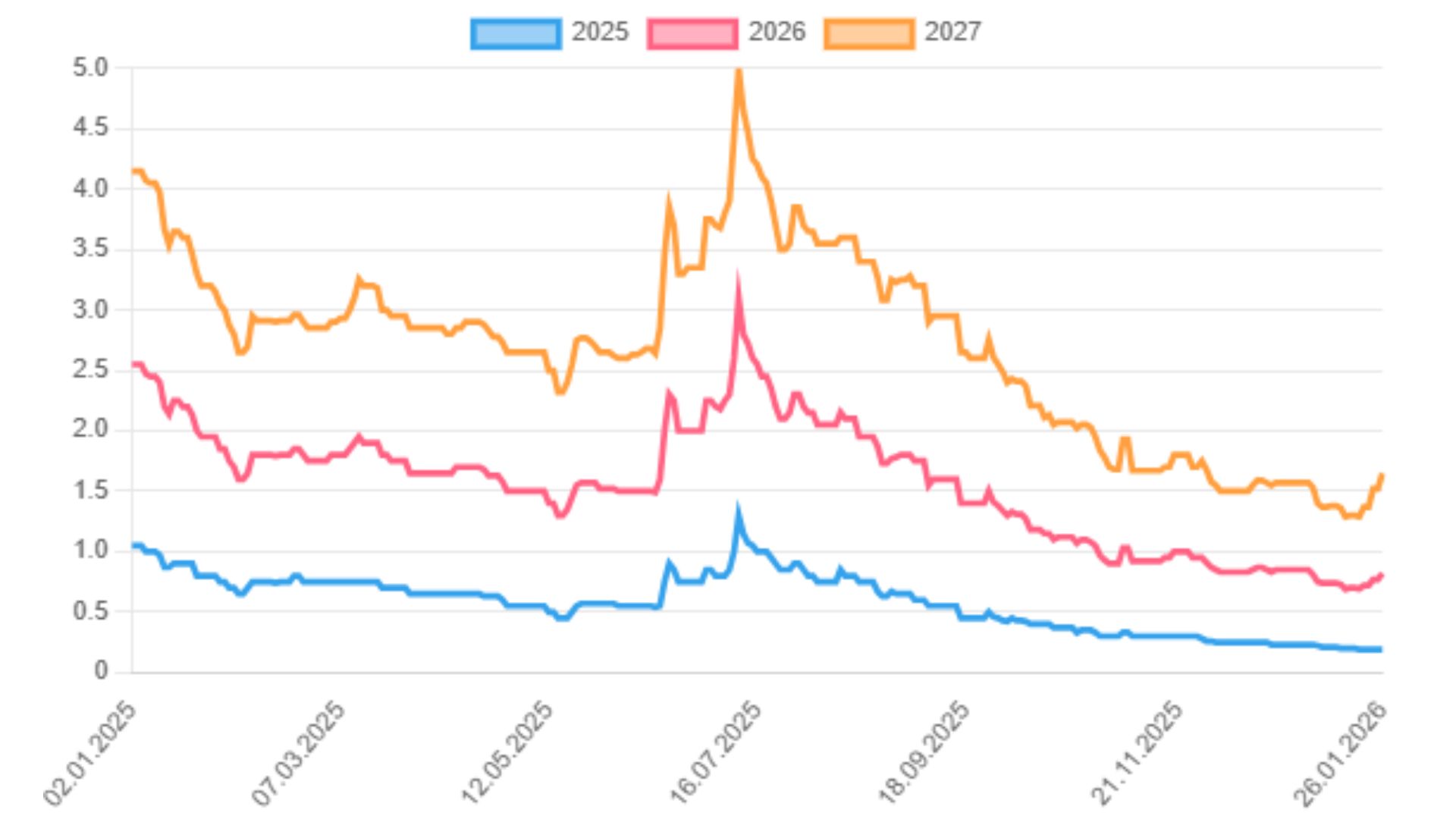
Five-year market price evolution of HWS GOs – production periods 2025–2026–2027

Figura 1: Andamento dei prezzi di mercato negli ultimi 5 anni delle GO HWS – periodi di produzione 2025–2026–2027

Fonte: dati di osservazione di mercato Nvalue.

Tuttavia, sulla base delle informazioni attualmente disponibili, ipotizziamo che le condizioni idrologiche tese osservate sia nei Paesi nordici sia lungo la catena alpina possano influenzare le dinamiche di offerta nei prossimi mesi. In tale contesto, è plausibile che alcuni produttori, avendo già venduto in anticipo una parte della propria produzione, siano soggetti a vincoli derivanti dalle rispettive politiche di gestione del rischio e adottino un approccio più conservativo, con una conseguente riduzione dei volumi ulteriormente offerti al mercato.

Come recita il celebre verso di Lorenzo de’ Medici – “di doman non c’è certezza” – un’espressione che si adatta bene anche ai mercati energetici e ambientali, il futuro resta per definizione incerto. Ciò che è invece possibile fare oggi è mettere sotto controllo il proprio esborso economico, trasformando un rischio potenziale in una scelta strategica consapevole.

Il contesto di mercato e i livelli di prezzo attuali

Gli attuali livelli di prezzo riflettono un mercato impostato su una forte prudenza. Il mercato delle Garanzie d’Origine ha già incorporato una serie di fattori ribassisti che hanno compresso le aspettative e mantenuto i prezzi su livelli contenuti.

Tra i principali elementi già scontati dal mercato rientrano:

  • la possibile disponibilità di volumi residui dall’anno precedente (rollover di GO);
  • l’entrata in esercizio di nuova capacità rinnovabile, stimata in almeno 10 TWh da nuovi impianti solari e oltre 20 TWh dall’eolico;
  • un contesto geopolitico incerto, caratterizzato da tensioni internazionali e instabilità regolatoria;
  • il ridimensionamento delle aspettative sull’idrogeno verde, con numerosi progetti rinviati o cancellati;
  • l’incertezza legata all’evoluzione della direttiva europea sui Green Claims;
  • l’ingresso di nuovi Paesi esportatori netti di Garanzie d’Origine nel circuito AIB, come la Bulgaria.

Nel loro insieme, questi fattori hanno contribuito all’attuale livello di prezzo, piuttosto contenuto. Tuttavia, questa configurazione riflette principalmente il passato recente e non necessariamente le dinamiche che potrebbero emergere nei prossimi anni.

Crescita della produzione rinnovabile in Europa

I dati Eurostat e i principali report di settore indicano che nel 2025 la quota di elettricità prodotta da fonti rinnovabili in Europa è ulteriormente cresciuta rispetto al 2024. Tuttavia, questa crescita non è stata omogenea tra le diverse tecnologie.

In particolare, l’aumento è stato trainato dal solare, mentre la quota relativa di eolico e idroelettrico si è ridotta. Questo aspetto è rilevante perché proprio eolico e idroelettrico rappresentano storicamente una parte significativa delle emissioni di Garanzie di Origine.

Fonte20242025 (Q3)Trend
Solare22-23%~38%Crescita significativa, trainata da nuovi impianti e stagionalità favorevole
Eolico39%~31%Leggera flessione in quota relativa, compensata dall’espansione del solare
Idroelettrico29-30%~23%Influenza della variabilità stagionale e idrologica
Bioenergia + Geotermia~8%~8%Contributo stabile

Nel complesso, la quota di rinnovabili sul totale dell’elettricità europea è passata dal 47,5% nel 2024 al 49,3% nel 2025. Tuttavia, la riduzione del contributo relativo di idroelettrico ed eolico suggerisce che il 2025 potrebbe registrare un livello di emissioni di GO inferiore rispetto all’anno precedente, nonostante l’aumento complessivo della produzione rinnovabile.

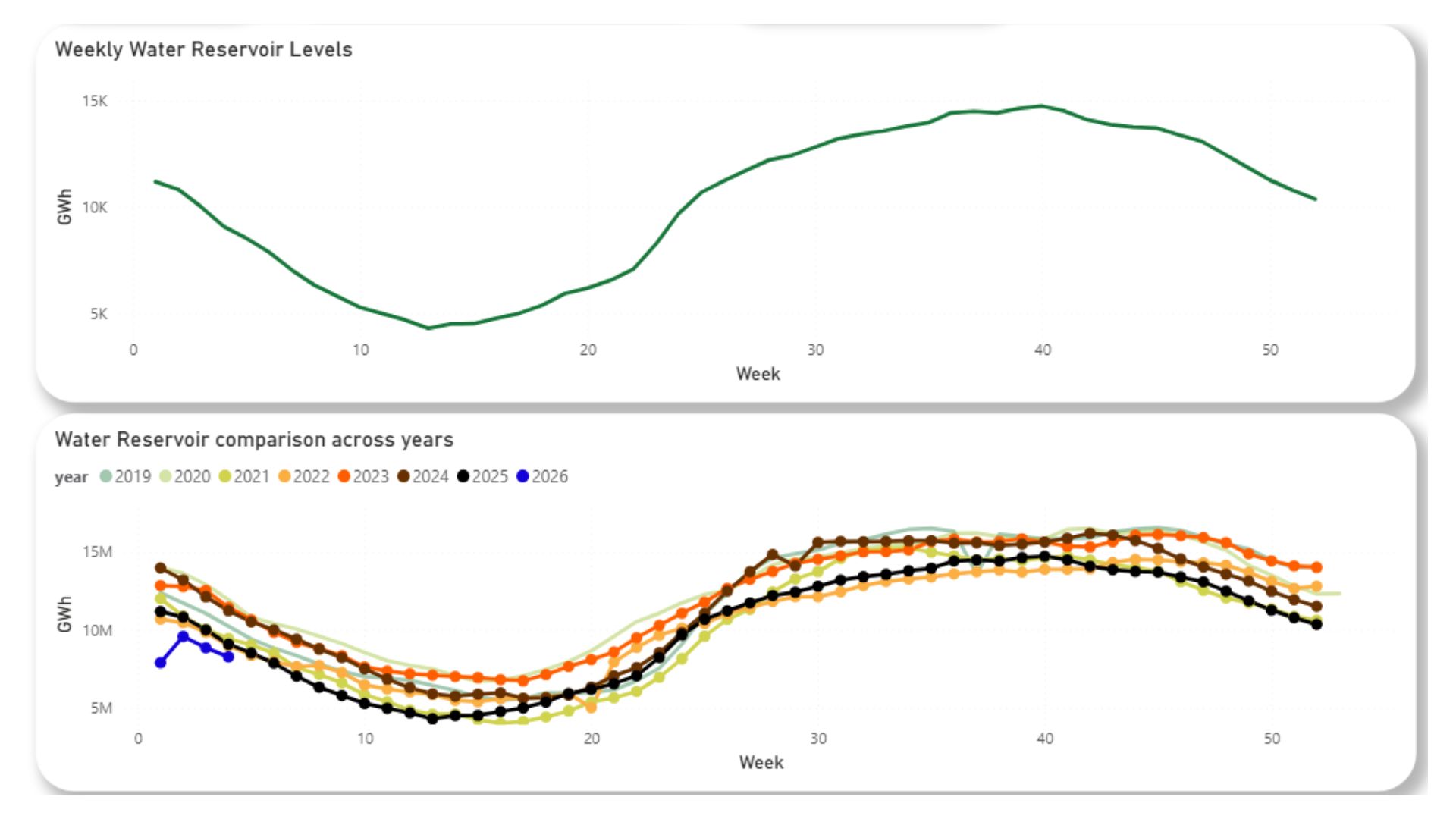
A questo si aggiunge l’andamento delle riserve idriche: nel 2025 non hanno replicato i livelli particolarmente favorevoli del 2024 e, in alcune aree europee — in particolare nella regione alpina — la situazione iniziale appare più debole, con analogie rispetto a contesti già osservati nel 2022.

Five-year market price evolution of HWS GOs – production periods 2025–2026–2027

Figure 2: Livelli delle Riserve d’Acqua nella catena Alpina

Fonte: elaborazione Nvalue su dati provenienti da fonti nazionali, tra cui RTE, Nord Pool Spot, SFOE e altre fonti ufficiali.

Proiezioni al 2030

Guardando al medio termine, diversi scenari europei convergono su un punto chiave: la domanda di elettricità rinnovabile è destinata a crescere in modo significativo entro il 2030. L’elettrificazione dei trasporti, del riscaldamento e di ampie porzioni dell’industria porterà a un aumento strutturale dei consumi elettrici.

In questo contesto, le analisi di settore stimano che il consumo di elettricità rinnovabile in Europa potrebbe aumentare fino a circa il 60% rispetto ai livelli attuali, a condizione che prosegua la diffusione di veicoli elettrici, pompe di calore, infrastrutture per l’idrogeno e data center.

Questo scenario implica una crescente competizione per l’accesso all’energia rinnovabile e ai relativi strumenti di tracciamento. In prospettiva, la disponibilità di elettricità verde e di Garanzie di Origine non dipenderà solo dalla capacità installata, ma anche dalla velocità con cui la domanda crescerà nei diversi settori.

I fattori rialzisti che peseranno sui costi per abbattere le emissioni Scope 2

Guardando al futuro, diversi fattori rialzisti non risultano ancora pienamente riflessi nei prezzi attuali delle Garanzie di Origine. Questi elementi riguardano sia il lato dell’offerta sia quello della domanda, oltre a cambiamenti regolatori e metodologici.

Sul fronte dell’offerta, si osserva una riduzione dei volumi disponibili in asta, in particolare da parte del GSE, con circa 40 TWh in meno rispetto al 2024. A ciò si aggiungono fattori strutturali come anni caratterizzati da cattiva idrologia e una minore produzione idroelettrica, che riducono l’emissione complessiva di GO.

Dal lato della domanda, crescono le pressioni legate allo sviluppo di data center e applicazioni di intelligenza artificiale. In Germania, a partire dal 2026, i centri ICT dovranno essere alimentati al 100% da fonti rinnovabili, introducendo una domanda rigida e difficilmente comprimibile.

Sul piano regolatorio, l’estensione dei programmi di aiuto di Stato a settori industriali energivori e l’evoluzione dei requisiti di rendicontazione — inclusi CSRD e CSDDD — continuano a coinvolgere aziende responsabili di circa l’88% delle emissioni europee. Parallelamente, gli obiettivi di decarbonizzazione delle grandi imprese si estendono lungo l’intera filiera, coinvolgendo fornitori e PMI.

Inoltre, l’adozione della RED II in Norvegia potrebbe favorire un aumento dell’utilizzo delle Garanzie di Origine, in quanto il metodo market-based sarebbe destinato a essere privilegiato nella tracciabilità dei consumi elettrici rinnovabili. Cambiamenti metodologici di questo tipo contribuiscono a rafforzare la domanda di strumenti di tracciabilità, incidendo sulle dinamiche di mercato.

Nel loro insieme, questi fattori aumentano il rischio di una pressione al rialzo dei prezzi nel medio termine.

Agire oggi: controllo dei costi, flessibilità e credibilità

Per le aziende industriali, intervenire oggi sulla copertura Scope 2 significa cogliere un duplice vantaggio: fissare condizioni economiche favorevoli e costruire un percorso di decarbonizzazione solido, credibile e difendibile nel tempo.

Attraverso un approccio strutturato al mercato delle Garanzie di Origine, Nvalue supporta le aziende nella definizione di strategie coerenti con il profilo di consumo, gli obiettivi industriali e i requisiti di rendicontazione. L’attenzione non è rivolta solo alla compliance, ma alla capacità di integrare le scelte Scope 2 in una visione di lungo periodo.

Il contesto attuale offre una combinazione rara: prezzi ancora accessibili in un mercato che, guardando avanti, presenta più rischi di rialzo che opportunità di ulteriore ribasso. In questo scenario, attendere significa esporsi all’incertezza; agire oggi significa governarla.


Approfondire oggi queste dinamiche è essenziale per prendere decisioni informate sullo Scope 2.

Contattaci


Continua a leggere

Policy position: opposing mandatory hourly matching in the GHGP Scope 2 guidance

Background

The Greenhouse Gas Protocol (GHGP) is considering making hourly matching electricity consumption with clean energy generation a mandatory requirement for Scope 2 reporting.

While motivated by the goal of accuracy, hourly matching risks undermining both the practicality and effectiveness of corporate decarbonization. It introduces high administrative complexity, distorts market incentives, and excludes smaller actors, all while delivering limited additional climate impact.

Our Position

Hourly matching should remain voluntary, not mandatory. Instead, efforts should concentrate on strengthening standard EAC systems through strict annual matching, as a proven driver of renewable growth and Scope 2 decarbonization.

Why Hourly Matching Misaligns with Market Design

Electricity systems operate within two distinct realities: physical reality and market reality. In physical terms, power grids continuously balance supply and demand in real time. Electrons do not travel directly from a specific producer to a specific consumer but instead oscillate across the interconnected system to maintain frequency and stability.

In market terms, these physical flows are represented through structured mechanisms that ensure reliability, efficiency, and transparency. In Europe, electricity is traded in integrated wholesale markets across several timeframes, including day-ahead and intraday markets where energy is bought and sold before its actual delivery, balancing markets used by system operators to correct real-time deviations, and capacity and ancillary service markets that ensure sufficient resources are available to maintain system security.

Alongside these wholesale markets, book-and-claim energy attribute certificate systems, such as the European Energy Certificate System (EECS), track how and where electricity is generated, enabling consumers to support renewable generation and make credible claims about their electricity use. These two layers work together in a mutually reinforcing way, even though they have distinct functions. The physical grid ensures that electricity flows safely and reliably at every moment, while the market layer supplies the pricing signals, investment incentives, and tracking systems that support long-term efficiency, transparency, and the expansion of renewable energy.

Mandating hourly matching conflates these realities, turning the GHGP into a grid operations standard rather than an accounting framework. It introduces artificial scarcity of “compliance hours” without improving actual emissions integrity.

Hourly EACs would duplicate the time and location price signals already embedded in power markets, while fragmenting liquidity in the EAC market itself. This overlap risks confusing market participants, increasing transaction costs, and discouraging participation in renewable certificate trading. Over time, such fragmentation could reduce the voluntary demand for renewable energy certificates, weakening one of the most effective financing mechanisms for new renewable projects.

Practical and Technical Overcomplication Without Added Integrity

While the idea of hourly matching may appear to improve temporal accuracy, in practice it introduces major administrative, equity, and market challenges that undermine the efficiency and inclusiveness of corporate decarbonization.

Implementing hourly matching would require companies to track, verify, and reconcile 8,760 hourly certificates per facility per year, often across multiple sites, suppliers, and grid regions. The process is highly complex, data-intensive, and costly, demanding new digital systems, integrations, and verification protocols. Instead of focusing on emissions reduction and renewable investment, companies would be forced to divert significant resources toward record-keeping. In short, the system risks prioritizing accounting precision over climate impact.

Only a handful of large corporations,  such as global tech or data center operators, have the technical and financial capacity to manage this level of complexity. For small and medium-sized enterprises (SMEs), the administrative and financial burden would be prohibitive.  A mandatory hourly system is exclusionary by design and would create an uneven playing field, concentrating participation among the largest energy buyers and undermining the open access nature that has made voluntary renewable procurement so successful.

Strengthen What Already Works: Standard EAC Systems

 Standard EAC markets already demonstrate a strong and proven track record of delivering real climate impact. They channel billions in revenue to renewable energy generators, creating stable and predictable income streams that support both the operation of existing projects and the development of new ones. By enabling consumers to choose and financially back clean electricity, these systems drive measurable additionality.

Beyond their environmental benefits, EAC markets are designed for scale and accessibility. They function seamlessly across borders, integrate with a wide range of energy systems, and remain accessible to companies of all sizes, which is why they have become one of the most powerful global tools for driving the energy transition. Tools such as strict annual matching and full consumption disclosure further enhance credibility and transparency while building on what already works, without disrupting market liquidity or participation. Strengthening and expanding this well-functioning foundation is a pragmatic, equitable, and high-impact pathway for continued decarbonization.


Conclusion

Hourly matching is granularity without real impact, a rule designed for ambitious appearance, without delivering concrete outcomes.It would complicate reporting, distort markets, and deter participation, while delivering little additional climate benefit. In our opinion, the GHG Protocol must remain a credible, transparent, and inclusive accounting framework, not a technical compliance hurdle.

To go deeper, Nvalue has produced a dedicated webinar that expands on every point with scenarios and cost implications.

Watch the dedicated webinar


Continua a leggere

COP30

COP30: ambition, contradictions, and an energy transition still held hostage in Belém

COP30 arrived with high expectations. After a year of extreme heat, relentless fires, and floods swallowing regions, there was hope that this would be the moment the world accelerated, not hesitated. And Belém did offer some genuine progress. Forest finance finally gained momentum, with new funding commitments and attention to tropical protection. Adaptation finance also saw a significant increase; a welcome response for countries already feeling the brunt of the impacts of the climate crisis before the rest of the world does.

But stepping away from the announcements and into the substance, it becomes clear that the real fault lines of global climate politics still run straight through the energy system. The climate crisis is accelerating; the solutions are known; yet the people with the most oil money continue to have the most influence over whether the world commits to using less oil. That tension shaped everything at COP30.

Finance rises, but we are spending more on surviving the crisis than stopping it

Countries agreed to triple adaptation finance by 2035 and backed the Baku–Belém roadmap mobilising roughly US $1.3 trillion a year. Adaptation, in plain terms, means paying for the damage we can no longer prevent: building defences, relocating communities, reinforcing infrastructure. It is vital, overdue, and it is a step in the right direction.

Yet the imbalance is striking. We are investing breathtaking sums to deal with consequences, while still dodging the most important choices needed to prevent the crisis from worsening. As BBC reporting showed, vulnerable nations left Belém grateful for the funding but deeply frustrated that fossil-fuel emissions, the root cause, remained largely untouched, and often undiscussed.

Sustainable fuels are set to ramp up, to an extent

One of the most enthusiastically announced outcomes was the Belém 4× pledge: a commitment to quadruple the production and use of sustainable fuels like hydrogen, biomethane, biofuels, and synthetic fuels by 2035. It sends a welcome signal that governments see clean fuels as essential for sectors that cannot fully electrify.

But there is an uncomfortable truth underneath. Quadrupling sounds bold until you remember how tiny many of these markets still are. When you multiply a very small number, you still end up with a small number. An absolute-volume commitment might have shown more certainty, however, the signal matters. Scaling sustainable fuels will be part of the long-term solution, just not if they are used as a shiny distraction from the bigger conversation about fossil-fuel decline.

Fossil fuels were once again the issue everyone danced around

And here lies the heart of the problem at yet another COP. For the third consecutive COP, countries failed to agree on phasing out fossil fuels. Delegates delivered stirring speeches about innovation and resilience, although they cautiously beat around the uncomfortable bush that is oil and gas, as production continues to rise in several major economies.

Vulnerable nations called this “a painful step backwards”, and scientists warned it undermines the credibility of every other achievement. Many observers wondered how the world can spend trillions adapting to climate breakdown, while refusing to name the industry driving it.

Article 6 moves forward, but the integrity debate refuses to die

Moving on, everything related to Article 6, the section of the Paris Agreement that governs international carbon trading, amounted to incremental improvements rather than anything transformative. Delegates agreed to give older CDM projects more time to transition into the new UN-supervised 6.4 mechanism, and they asked for updated methodologies and stronger community safeguards to lift overall quality.

Still, the same structural weaknesses remain. Some countries pushed to soften environmental rules that protect against unreliable or short-lived carbon credits, and although those attempts were stopped, the final Article 6.2 outcome remains weak on transparency and oversight. In practice, this means the market will keep expanding, although not all credits entering it will meet the standards needed for credible climate claims. The integrity debate is far from solved, and COP30 made that explicit.

Implementation platforms take shape, though without resolving the core contradiction

Finally, the Global Implementation Accelerator and the Belém Mission to 1.5 °C were introduced as new tools to help countries turn their plans into action. They are constructive additions, although they do not answer the central question everyone quietly acknowledged; implementation cannot succeed while fossil-fuel production remains untouched.

Without resolving that contradiction, these platforms risk becoming well-intentioned placeholders rather than transformative engines.

What this means for corporate energy and climate strategy

The takeaway for companies is clearer than the politics:

  • Keep pursuing transparent and verifiable renewable-energy procurement; it remains the backbone of credible decarbonisation;
  • Expect rising demand for certified sustainable fuels, although track the real-world scaling rather than the headline pledges;
  • Navigate carbon markets with discernment, because Article 6’s progress does not mean all credits are equally credible; and
  • Focus on genuine emissions reductions across operations and supply chains; waiting for political alignment is not a strategy.

A closing thought

COP30 will be remembered as a summit of ambition and contradiction, not too dissimilar to COP29, or COP28 for that matter. It advanced forest protection, strengthened adaptation finance, and boosted sustainable-fuel visibility. But it also exposed the persistent unwillingness to confront fossil-fuel production head-on, even as climate damages grow more severe, more expensive, and far more visible across the globe.

The climate crisis is moving quickly, but politics is not. That gap is precisely where companies need to lead; by securing credible renewable energy, investing in clean-fuel pathways, and reducing emissions in ways that survive scrutiny.

If you’d like a clear path for what to prioritise next, from clean energy to credible decarbonisation, we’re ready to support you.

Contact us


Continua a leggere

Another turn in the EU’s sustainability Omnibus package story

The EU’s sustainability Omnibus package landed as a shock from the very beginning. Its introduction earlier this year immediately raised alarms across the sustainability community, not because it adapted existing rules, but because it signalled a fundamental scaling back of the EU’s green-reporting ambitions. Then, in a surprise secret vote in late October, the European Parliament rejected the simplification measures, which for a moment seemed like a pause in the rollback tide. Shortly afterwards, however, the Parliament adopted a negotiating position on 13 November 2025 that restores many of the most significant reduction measures.

This drama illustrates how the regulatory pathway for corporate sustainability in Europe remains far from stable, where ambition and retreat exist side-by-side in uneasy tension. Many stakeholders across the sustainability landscape have expressed frustration and dismay. In a moment of intensifying climate risk, the vote threatens to relegate reporting obligations to, as some have called it, little more than “performative exercises”.

What the decision means in practical terms

The vote tally was 382 in favour, 249 against, 13 abstentions. The amendments introduced by the Parliament on Omnibus include:

For the Corporate Sustainability Reporting Directive (CSRD):

  • Companies will now fall into scope only if they have more than 1,750 employees and net turnover of more than €450 million.
  • Companies that are mere holding companies, without EU operating subsidiaries, may now be excluded.
  • Reporting entities will be prohibited from seeking information from value-chain partners with fewer than 1,750 employees or €450 million turnover, except where standards explicitly allow.

For the Corporate Sustainability Due Diligence Directive (CS3D):

  • The thresholds have been raised so that only companies with more than 5,000 employees and net worldwide turnover of more than €1.5 billion will be in scope.
  • The requirement to adopt a climate-transition plan (Article 22) has been removed.

The position adopted narrows scope significantly, limits reporting obligations, and weakens certain supervisory or liability features.

Why sustainability reporting remains economically essential

Even in a time where regulatory demands may soften, robust sustainability data and thorough due-diligence practices continue to matter. They are central to risk-management, to market credibility, and to future business positioning.

Risk management and resilience

Deployment of high-quality data helps companies identify how climate change, biodiversity loss and human-rights issues may affect operations or supply chains. These influences penetrate the financial ledger: from increased insurance premiums to disrupted supply lines, from heightened regulatory penalties to shifts in investor sentiment. Being transparent and prepared provides resilience when conditions shift.

Access to capital and competitive edge

Banks, investors and large corporate customers continue to press for credible ESG information, no matter how the law evolves. Market expectations often outpace legislation. Businesses that stay disciplined with their disclosures frequently enjoy better financing terms, higher trust among stakeholders and clearer alignment with supply-chain demands.

Strategic value creation

Far from a mere compliance exercise, sustainability disclosure now speaks to long-term strategy. Clear transition plans and transparent metrics help customers, partners and investors assess how a company intends to navigate the low-carbon economy. For organisations using energy-attribute instruments such as GOs, i-RECs or other EACs, credible baseline data and ongoing traceability remain essential to telling a genuine decarbonisation story. In this light, sustainability is shaping business growth, innovation and procurement, not just fulfilment of reporting obligations.

Looking ahead

The Parliament’s mandate now moves to trilogue negotiations involving the European Commission and the Council of the European Union. The final directive has not yet been adopted, and its exact form may shift as the legislative process progresses.

For companies, this moment should not be read as a cue to reduce ambition. Despite the regulatory tone, investor expectations, supply-chain dynamics and market pressures continue to lean toward greater transparency. Those who continue to move ahead now will be better prepared when clarity and stability eventually return.


A note of hope

While the outcome of the vote may be disappointing for many in the sustainability ecosystem, it does not mark the end of efforts for effective corporate disclosure. The broader need still remains clear though, with the goals of the Paris Agreement, the commitments to nature and human-rights, and the shifting preferences of investors all continue to drive demand for real, verifiable sustainability action.

In that sense, the latest vote may serve as another wake-up call, rather than a final verdict. For companies willing to maintain strong transparency and align business strategy with sustainability in earnest, there remains a path forward. The regulatory rules may shift, but the fundamental logic of sustainability as strategic value remains unchanged.

Nvalue will follow the progress closely and share updates with you.

Contact us


Continua a leggere

GHG Protocol Debate Re-Source

The GHG protocol debate: who gets left behind in the push for precision?

The Greenhouse Gas Protocol, the world’s most influential emissions-accounting standard, is under revision, and what happens next could reshape how companies report, act, and define progress.

At Re-Source 2025, one of the most talked-about side sessions, “Evolving ESG Strategies: What You Need to Know About the Greenhouse Gas Protocol and SBTi,” unpacked what these changes could mean in practice. It wasn’t a polished, everyone-agrees-with-everyone panel. It was tense, opinionated, and refreshingly honest.

The revision

The GHG Protocol is undergoing its biggest update in more than a decade and the proposed changes could redefine what counts as credible decarbonisation and who gets to claim it.

Depending on who you ask, the revisions are either a long-overdue clean-up to restore legitimacy to carbon reporting, or a bureaucratic overcorrection that risks making participation nearly impossible for most companies.

The market-based method under scrutiny

One of the first topics to ignite debate was the market-based method itself. It’s a common misconception, one we didn’t expect to see resurface, but it remains the first point of concern for many.

The criticism goes that buying unbundled Energy Attribute Certificates (EACs) is just a paper exercise, a convenient way to make green claims without real impact. But that view misses the bigger picture. The market-based method is what unlocked private capital for renewable generation in the first place by allowing companies to purchase certificates representing renewable electricity attributes. It created a transparent, verifiable mechanism to stimulate demand, and with it, investment.

Since its introduction, this approach has channelled billions into renewable projects worldwide, with entire markets having been built on its foundation. It isn’t without flaws, but it’s effective and it has played a decisive role in shifting corporate behaviour towards clean energy.

For a deeper look at why the market-based method isn’t greenwashing and why it remains one of the strongest tools for scaling renewable demand, read our breakdown here.

From “Good Enough” to “Granular”

The session quickly turned to what many saw as the next big pivot, and why most of us were in the room in the first place: granularity.

The proposed update would require renewable electricity reported under the market-based method to be hourly matched with consumption and sourced from within the same grid region or bidding zone.

In theory, more precise data should make reporting more credible. In reality, very few organisations can reach that level of detail. Even major corporates with vast energy portfolios find that aligning consumption and generation hour by hour is technically demanding and not necessarily more impactful.

Meta shared their 2023 study with the room, which illustrates this point. Under the standard annual method, Meta’s reported electricity emissions were near zero, supported by more than 15 GW of long-term clean-energy contracts covering its entire annual use. When reassessed hourly, Meta achieved a 79 % Carbon-Free Energy (CFE) score, which they highlighted was impressive on paper, but far less meaningful once grid congestion, transmission losses, and regional variations were considered.

The analysis further showed how hourly matching can distort priorities. It’s easier to achieve precise hourly matches in places like California, where renewables dominate and data are plentiful, than in regions that still rely on fossil fuels; the ones that actually need investment most.

A question of fairness

Granular data is appealing if you’re a global tech company with the infrastructure to analyse it. But what about everyone else?

Across Europe, 99.8 % of companies are small or medium-sized enterprises. These are the manufacturers, logistics operators, and service providers forming the economic backbone of the continent. Most lack access to hourly consumption data or the capacity to source certificates within defined market zones.

If the new Protocol demands such precision, it risks excluding the majority of businesses that are genuinely trying to decarbonise, exposing a deeper structural problem. Several speakers warned that the discussion is increasingly shaped by those with the resources to meet ever-stricter criteria, and others stressed that if the system only serves the biggest players, it fails its purpose entirely.

The overwhelming majority seemed to nod in agreement with claims that this isn’t about perfection; it’s about practicality. Decarbonisation must happen in numbers, and although large corporates should lead with precision and transparency, smaller ones must be supported and encouraged to act as well, not deterred.

Boundaries that bind

Another contentious proposal is the tightening of market boundaries, redefining the regions within which EACs can be sourced and counted toward a company’s inventory.

In Europe, these boundaries are expected to align with ENTSO-E bidding zones, which, in countries like Italy, could create several (up to five) separate market areas. While this might improve data consistency, it could also restrict flexibility for certificate buyers.

With fewer eligible options, companies will have less room to manoeuvre and likely less impact overall. A certificate from a region with a dirtier grid can deliver a far greater emissions benefit than one from a cleaner system, yet under the new structure the former might no longer qualify.

For organisations operating across multiple regions or bidding zones, the implications go beyond impact. Managing separate accounting and sourcing requirements would bring new layers of administrative cost unrelated to renewable energy itself; costs that could discourage participation and push companies to focus only on their largest sites, leaving smaller operations behind.

It’s a case of accounting accuracy overshadowing climate logic: a trade-off worth questioning.

GHG Protocol

Quality or Scale?

Underlying it all is a simple but uncomfortable dilemma. Should the GHG Protocol prioritise perfect accuracy or broad participation?

Some argued that companies should only report if they can supply fully granular data. Others countered, more pragmatically, that waiting for perfect datasets is just another way to delay progress.

What often gets lost in these debates is that the existing Protocol already works. It has helped drive hundreds of terawatt-hours of renewable procurement and guided billions in investment. Through the market-based method, companies of all sizes have found a credible way to support renewable generation and track progress transparently. Without it, we would likely be years behind where we are today.

So, where do we stand?

At Nvalue, our position is clear. We support the market-based method, not because it’s perfect, but because it’s pragmatic. It enables participation across industries, countries, and company sizes. It creates incentives for renewable investment, not just reporting.

We are not in favour of increased granularity, not because we oppose better data, but because we oppose turning “better data” into a luxury.

The revised GHG Protocol must remain inclusive, practical, and focused on outcomes rather than optics. If it ends up serving only those who can afford hourly-matching algorithms, it will have missed its purpose entirely.

As one participant noted, if you build the perfect system that no one can use, what exactly have you achieved?

The bigger picture

Standards like the GHG Protocol are not natural laws; they’re voluntary frameworks. Their power lies in adoption, not enforcement. They shape corporate behaviour, steer investment, and, crucially, define what “counts” as progress. If we make them so complex or costly that companies choose not to participate, we risk losing the very momentum that has made them effective in the first place.

Over the past decade, that imperfect definition has driven one of the largest voluntary movements in clean energy history. Companies bought certificates, reshaped procurement strategies, and directed capital toward renewables on an unprecedented scale.

So yes, the system could use refinement, but we should be careful not to perfect it out of existence.

Our hope for the revision

As the consultation continues, our hope is straightforward: listen to the many, not just the loud. It’s easy to design a standard that works for the world’s richest corporations. It’s harder, and far more important, to build one that empowers everyone else.

The GHG Protocol has never been about perfection. It’s been about progress. We vote to keep it that way. Nvalue will track the progress and keep you informed.

Contact us


Continua a leggere

From Baku to Belém: where COP29 left us and what COP30 now must deliver

As the world heads towards COP30 in Belém, the climate negotiation process stands at a critical juncture. Science is now unequivocal, and we are already in the final years of the remaining carbon budget for 1.5°C, with every fraction of a degree of additional warming translating directly into higher physical risks, and higher adaptation costs.

COP29 in Baku established a new, higher finance target — but did not define the instruments and rules for delivering it. The central questions are increasingly operational – how fast emissions fall, how climate finance is structured, and how the transition is governed in a way that is economically and socially workable. COP30 will therefore be a critical moment to convert scale into structure, and to turn general agreement on direction into actionable systems.

After Baku: unresolved structural gaps

COP29 in Baku will be remembered primarily for agreeing a new and higher climate finance target of 300 to 400 billion dollars per year by 2030. This is structurally significant because it acknowledges the scale of capital required for transition in emerging markets. However, it stopped there. No burden sharing model was agreed. No definition of what counts as climate finance was settled. There is no clarity on the balance between public and private flows, nor any safeguards to prevent the transition from being financed through additional debt for already highly indebted countries.

In parallel, negotiations on carbon markets (Article 6) again failed to close key technical gaps. Verification, integrity standards, and double counting rules remain unfinished. The global fossil fuel phase out language agreed at COP28 was not operationalized into sectoral or national pathways. Adaptation finance and Loss and Damage finance remain underdeveloped in terms of predictable annual replenishment and access modalities.

In Belém: from ambition to operating system

COP30 in Belém is positioned as the moment where climate diplomacy needs to convert strategic direction into practical systems. The finance architecture is the most central task, and agreement is needed on who pays how much, what instruments are used, how money is deployed (grants, concessional capital, guarantee structures) and how delivery is monitored with transparency and accountability.

The fact that Brazil is hosting in the Amazon brings an additional layer of relevance and urgency. COP30 is expected to elevate forests, land use, biodiversity and food systems from side streams into a main pillar of climate action and finance. COP30 is also the formal deadline for countries to submit their next round of Nationally Determined Contributions (NDCs) under the Paris Agreement’s ratchet-up mechanism, making Belém the decisive moment to secure economy-wide commitments that go beyond mitigation and also integrate adaptation, finance and loss-and-damage. And there will be renewed pressure to take the “transition away from fossil fuels” language and translate it into actual phase out trajectories aligned with 1.5°C.
At the same time, the 2025 US decision to withdraw again from the Paris Agreement has introduced additional geopolitical uncertainty that will inevitably shape how robust and enforceable any finance system can become in Belém.

As the world marks 10 years since the Paris Agreement, credibility now depends less on new targets and more on the construction of rules, traceability and enforcement. COP30 will not be assessed by its declarations, but by whether it produces systems that actually drive measurable implementation, closing what COP29 could not.


Nvalue will continue to closely monitor the developments and outcomes of COP30. Stay tuned for our full wrap-up article coming soon.

Contact us


Continua a leggere

VSME: A new framework for sustainability in European SMEs

VSME: a new framework for sustainability in European SMEs

With the progressive rollout of the CSRD and ESRS, sustainability reporting has become mandatory for all large European companies. But what about SMEs, which are often asked to provide ESG data to clients or financial partners, without themselves being directly subject to the directive?

To bridge this gap, EFRAG and the European Commission published the VSME (Voluntary Sustainability Reporting Standard for non-listed Micro-, Small-, and Medium-sized Enterprises) in December 2024: a voluntary standard designed to harmonize and simplify extra-financial communication for SMEs, while safeguarding their competitiveness. While the framework brings several advantages, it is not without controversy—this article explores both sides.

What is the VSME?

The VSME is a voluntary, harmonized framework intended for non-listed SMEs in Europe. It aims to provide them with a simple, proportionate, and widely recognized way to communicate their sustainability commitments and performance, without facing the complexity of the ESRS imposed on larger companies under the CSRD.

In practice, the VSME acts as a common language between SMEs and their stakeholders, streamlining ESG data exchanges across the value chain.

What are its objectives?

The initiative provides SMEs with a pragmatic framework to address the growing importance of sustainability. Under pressure from clients, investors, banks, and public procurement, SMEs need to demonstrate their ESG commitments without being overwhelmed by administrative burdens.

Concretely, the VSME seeks to:

  • Reduce the administrative burden: by replacing multiple, often inconsistent ESG questionnaires with a harmonized set of indicators.
  • Facilitate access to sustainable finance: by equipping SMEs with transparency tools that strengthen their credibility with financial stakeholders and help them showcase their environmental and social initiatives.
  • Support integration into public procurement and responsible supply chains: by meeting the rising demand from buyers for tangible ESG evidence in partner selection.
  • Prepare for the future: by familiarizing SMEs with regulatory expectations in sustainability reporting, anticipating the likelihood of more stringent requirements ahead.

A two-tier standard

To avoid placing excessive strain on companies willing to engage, the VSME was designed with two reporting modules, allowing for a gradual approach depending on maturity levels:

  • The “basic” module
    Covers a limited yet essential set of indicators (greenhouse gas emissions, energy consumption, anti-corruption practices, key social data, etc.).
    Objective: enable any SME, even those less experienced with ESG, to provide a credible minimum set of information.
  • The “comprehensive” module
    Provides a broader and more narrative-based approach.
    Objective: allow companies to meet more advanced ESG expectations, for example from institutional investors or large corporations subject to the CSRD.

This modularity makes the framework flexible and better suited to the diversity of European SMEs.

VSME: What are the benefits for SMEs?

The VSME was designed as a practical response to SMEs’ need for clarity and proportionality in sustainability reporting. It allows them to move forward step by step, reaping the benefits without being crushed by the requirements imposed on larger companies:

  • Standardization: a single, EU-recognized format that replaces the jungle of multiple and sometimes contradictory requests from clients, investors, or financial institutions.
  • Flexibility: the ability to tailor reporting levels to the company’s resources, maturity, and priorities, enabling SMEs to progress at their own pace.
  • Credibility: developed by EFRAG and validated by the European Commission, the standard carries strong institutional legitimacy and recognition across the business ecosystem.
  • Future readiness: a first step toward more advanced sustainability practices, helping SMEs anticipate future obligations without immediate regulatory pressure.

A framework under scrutiny

While the VSME’s main purpose is to simplify SME reporting, it has also raised concerns. Several stakeholders—experts, investors, and business representatives—point to unresolved issues that could limit its effectiveness:

  • Divergence with the ESRS: large companies must publish more stringent data, especially on Scope 2 emissions. The VSME currently only requires the location-based method, making the market-based method (linked to Guarantees of Origin) optional. This gap could complicate data alignment between SMEs and larger corporations.
  • Risk of two-speed reporting: SMEs sticking to the basic module may provide information seen as too limited by certain investors, weakening the standard’s added value as a bridge to sustainable finance.
  • The real burden for SMEs: even simplified, reporting requires time, expertise, and sometimes digital tools—resources that smaller firms may lack, especially given their already heavy administrative workload.

Key takeaways

By offering a voluntary, simple, and recognized framework, the VSME addresses a real need for clarity and proportionality in an environment where ESG requests are multiplying.

Its main strengths make it a promising tool to enhance SME competitiveness across the value chain. However, challenges remain: the risk of a two-tier system, divergences with large-company standards, and the practical burden for smaller firms.

The effectiveness of the VSME will therefore hinge on two commitments:

  • From SMEs, to gradually adopt and leverage the framework.
  • From large companies and investors, to acknowledge the standard’s legitimacy and refrain from demanding more than it requires.

Ultimately, the VSME could become a genuine bridge between SMEs and the sustainable finance ecosystem—provided the balance between simplicity and credibility is preserved. More than a technical standard, it represents a strategic lever to help SMEs prepare for tomorrow’s requirements while staying competitive today.


Want to know how the VSME can fit into your business practices? Nvalue’s team will guide you step by step in setting up your sustainability reporting.

Contact us


Continua a leggere

decarbonisation SME

What Happens When SMEs Ignore Decarbonisation?

Micro, small and medium enterprises (SMEs) represent 99% of all businesses in Europe and two-thirds of total private sector employment, yet most of these enterprises remain without a structured plan for reducing their greenhouse gas emissions.

Standing still now comes at a cost — including higher energy bills, tougher financing, exclusion from tenders, and a growing reputational gap. Since SMEs form the backbone of supply chains, inaction doesn’t just put them at risk — it weakens the corporates that depend on them.

When SMEs stall on decarbonisation, supply chains stall with them. And when supply chains stall, entire industries lose credibility. Therefore, understanding what is at stake — and what practical steps SMEs can take today — is critical for resilience and competitiveness.

Why sustainability still matters

Political winds are shifting. Across Europe, right-wing parties are gaining ground, often campaigning against perceived “green overreach.” In the United States, the Trump administration has already signalled a reversal of many climate and sustainability initiatives. Even within the EU, once a global leader on climate policy, momentum has slowed.

For many SMEs, this creates confusion. If politics is turning away from sustainability, does it still make sense to invest? The answer is yes — but only if we see sustainability for what it really is: the capacity to endure over the long term.

Companies that dismiss it as a passing fashion risk missing the point: while labels may change, the underlying drivers remain. Energy efficiency, risk management, and resource optimisation are not political slogans; they are business fundamentals.

Why SMEs can’t afford inaction

While political headwinds may change the language, they aren’t going to change direction. Pressure to decarbonise now comes from all sides — clients, financiers, and the market itself. Companies that anticipate and manage these risks will continue to be rewarded, regardless of political trends.

This dynamic plays out most clearly in supply chains. With the Corporate Sustainability Reporting Directive (CSRD), large companies must disclose material impacts across their value chains. Under the recent Omnibus simplification proposal, this obligation is tempered by a so-called “value-chain cap”, limiting how far reporting companies can demand data from upstream and downstream partners.

While this adjustment may reduce the immediate burden on smaller firms, it does not eliminate it. SMEs remain central to corporate disclosures, and many will still be asked to provide emissions or energy data, particularly if they are tier-1 or tier-2 suppliers. Over time, these expectations are likely to deepen — meaning SMEs that delay action risk exclusion from procurement processes.

Finance is the second driver. Banks and investors are under pressure to align portfolios with the EU Taxonomy and Sustainable Finance Disclosure Regulation (SFDR). This translates into greater scrutiny of borrowers’ climate performance, and for SMEs, the absence of a decarbonisation plan may soon mean higher interest rates, restricted access to credit, or even exclusion from sustainability-linked financing.

The market itself is the third driver. Buyers, whether consumers or B2B clients, are increasingly choosing products and services with credible sustainability credentials. Reputation now plays a key role not only in attracting customers but also in retaining talent and securing partnerships.

Despite shifting political rhetoric, evidence shows that younger generations — both as consumers and employees — place greater value on climate and social responsibility. For SMEs, that means the demand for credible action will only intensify.

Taken together, these pressures form a reinforcing loop: supply chain requirements drive data requests, which influence financing conditions, which in turn shape market perception. Inaction by SMEs is therefore not a neutral choice: it is a direct risk to revenue, cost of capital, and competitiveness.

The financial consequences of inaction

For SMEs, the financial risks of ignoring decarbonisation are already materialising:

  • Cost escalation: Reliance on fossil energy exposes SMEs to volatile prices, further amplified by the expansion of the EU ETS into ETS2.
  • Revenue risk: Corporate buyers increasingly embed sustainability requirements into tenders. SMEs unable to comply risk losing contracts to more proactive competitors.
  • Reputational risk: Companies that cannot demonstrate progress appear “behind the curve,” undermining their ability to retain customers and attract talent.
  • Compliance risk: While most SMEs are not directly in CSRD scope, their exposure is indirect. Failing to provide data to corporate partners can strain relationships, trigger penalties, or lead to contract loss.

Practical entry points for SMEs

The good news: SMEs are not expected to decarbonise overnight. What matters most is to demonstrate credible first steps. These actions send a clear signal to clients, financiers, and employees that sustainability is being taken seriously.

  1. Carbon footprinting – establish your emissions baseline

A basic carbon footprint assessment provides SMEs with a credible starting point. Even a high-level calculation demonstrates awareness and commitment.

  1. Energy efficiency – cut waste and save costs

Simple measures — upgrading lighting, optimising HVAC systems, or improving fleet efficiency — deliver immediate savings while reducing emissions.

  1. Energy Attribute Certificates (EACs) – address Scope 2 emissions

One of the most straightforward options for SMEs is the use of Energy Attribute Certificates (EACs) — including Guarantees of Origin (GOs) in Europe, I-RECs internationally, and RECs in North America.

By purchasing and cancelling these certificates, companies can credibly report renewable electricity use under the Greenhouse Gas Protocol (GHG Protocol). For SMEs facing supply chain pressure, EACs offer a fast, credible solution to reduce Scope 2 emissions and show commitment while preparing for long-term strategies.

  1. Sustainability ratings and certifications – demonstrate credibility

Recognition through platforms such as EcoVadis, CDP, or local sustainability labels helps SMEs benchmark performance, prioritise actions, and unlock opportunities.

For corporate clients, these certifications provide confidence that SMEs are serious about progress. Even an entry-level score signals commitment and can unlock commercial advantages in tenders and partnerships.

Inaction is not neutral

For SMEs, ignoring decarbonisation carries economic and financial risks that will only grow — including supply chain exclusion, reduced financing options, higher energy costs, and reputational damage.

The solution does not need to be complex. By starting with carbon footprinting and adopting accessible tools such as Energy Attribute Certificates, SMEs can demonstrate credible progress, satisfy client expectations, and enhance competitiveness.


Nvalue will be hosting an upcoming session dedicated to SMEs and the importance of decarbonisation. We will unpack practical steps, show how energy certificates can be applied effectively, and share insights on how SMEs can future-proof their businesses in a rapidly changing market.

Join us to explore how SMEs can move from risk to resilience, and why ignoring decarbonisation is no longer an option.

Register


Continua a leggere

Notes from Climate Week NYC & IETA NACS

Notes from Climate Week NYC & IETA NACS

Cutting Through the Noise for Corporate Buyers

This year’s Climate Week in New York, alongside IETA’s North America Climate Summit, offered a clear view of where corporate decarbonisation is heading and where buyers can act with confidence today. Across CEBA sessions, investor-facing panels, and market deep dives, three threads kept reappearing: procurement must be de-risked, disclosures must be decision-useful, and data must travel cleanly across systems. In a crowded week, these were the signals worth keeping.

From strategy to execution

At CEBA’s member forum the conversation was refreshingly pragmatic. Buyers are recalibrating toward portfolios that mix long-term instruments with near-term impact. Traditional PPAs remain central for companies with the balance sheet and load profile to match tenor and risk. Yet many are right-sizing exposure by complementing PPAs with unbundled EACs, GO and I-REC strips, and shorter structured options to maintain progress while markets and internal approvals catch up. The shared objective was resilience: keep Scope 2 momentum visible quarter by quarter, while larger assets move through diligence, interconnection and financing.

What this means for a buyer: treat procurement as a curve, not a point. Lock in foundational positions where you can, then maintain coverage and optionality with diversified certificates and forward strips. A portfolio approach reduces timing risk and communicates continuity to internal stakeholders.

Disclosures that investors can actually use

Panels hosted like the one by Agendi moved past slogans to the mechanics of climate reporting. The direction of travel is clear. ISSB and TCFD concepts are informing rules in California and the EU, and the market is converging on a small set of expectations: align risk to cash flows, show governance, quantify Scope 1–3 with defensible methods, and explain variance over time. The most credible reports are folding sustainability into the financial narrative, not publishing it alongside. Assurance is moving from a nice-to-have to a natural extension of investor relations.

What this means for a buyer: build your energy procurement story the same way you would a capital allocation memo. Link instruments to exposure, explain why a PPA here and a certificate strip there, specify the controls on data quality, and prepare for limited assurance. The question is no longer if climate information is investment-grade, but when yours will be.

Speed without theatre

A recurring theme at the week’s workshops was friction at the enterprise edge. Startups spoke candidly about pilot projects that stall between enthusiasm and execution. Corporates described internal handovers that add six to twelve months before decisions land. The way through is not more theatre. It is operational clarity, credible measurement, and well-chosen partnerships that shorten cycles without inflating claims.

What this means for a buyer: ask vendors for the simplest path to measurable outcomes in the next two quarters, then scale. Scope 3 initiatives benefit from the same discipline. Prioritise supplier cohorts where data can be gathered and verified, use consistent methodologies, and be transparent about baselines and limits. Progress compounds when definitions are stable.

Markets that are maturing, not pausing

IETA and NACS sessions confirmed what many suspected. Compliance systems are deepening and aligning, voluntary markets are tightening around quality, and Article 6 is moving from concept to frameworks with real accountability. Aviation’s CORSIA and state leadership in North America are reinforcing the signal that carbon markets will remain part of corporate pathways, provided integrity standards are met. Data interoperability matters here. Certificates, claims, and audits must move smoothly across registries and reporting systems. Buyers are asking for fewer platforms, fewer spreadsheets, and a single chain of custody for evidence.

What this means for a buyer: choose market instruments that can be traced, audited, and defended. Ask how issuance, retirement, and claims will be documented against your ledgers and reports. If an instrument improves decarbonisation optics but complicates assurance, it will cost you time later.

PPAs, certificates, or both

A useful rule emerged during side-room discussions. If your primary objective is cost and hedge value, look to procure EAC strips on a multi-year period or if you’re able to withstand the long-term risks of 15 year or longer contracts, VPPAs or PPAs could be a better fit. If your objective is coverage, speed, and geographic breadth while maintaining the same tracible impact that comes with longer term arrangements, prioritise EACs, GOs, and I-RECs with transparent provenance and quality screens. Most programmes will need both. The art is phasing. Many buyers indicated near-term actions in October and November to secure 2025 coverage while 2026–2028 assets are evaluated.

What this means for a buyer: time your instruments to your objectives. Fix what you can fix quickly. Build what must be built carefully. Report both with the same precision.

Assurance is becoming the default

The week also underscored that assurance is not only about avoiding greenwash. It is about trust between functions. When risk, finance, sustainability, and investor relations share a single view of data lineage and control, internal debates shorten and external conversations improve. Auditors will not solve strategy, but they will clarify signals. That is valuable in a noisy market.

What this means for a buyer: assume your disclosures will be read by people trained to reconcile numbers. Organise your energy data so that it can be assured with minimal translation. You will move faster when you do.


A Swiss perspective

At Nvalue we take a measured view. Markets reward clarity, not volume. Instruments are tools, not ideologies. The best programmes are rigorous, calm and repeatable. Our role is to help buyers assemble portfolios that are defensible today and adaptable tomorrow, with documentation that travels cleanly from procurement to reporting. It is less about promising the perfect system and more about delivering progress you can account for while the system continues to mature.

The path ahead

Climate Week and NACS did not produce a single answer, and that is healthy. They did clarify how buyers can cut through the noise.

  • Build a portfolio, not a headline.
  • Tie instruments to risk, cash flows, and disclosure.
  • Demand data that can move from meter to audit.
  • Use assurance to speed decisions, not slow them.
  • Act in quarters and plan in years.

If you are preparing near-term coverage while designing longer-dated positions, we can help you do that with precision. If you are aligning procurement with ISSB-style reporting and upcoming state or EU rules, we can help you make the controls as strong as the claims. And if you simply need a clearer map of options for PPAs and certificates across geographies, we will give you one that is useful on Monday morning.

Pragmatism and credibility remain the edge. The market is ready for both.

Contact us


Continua a leggere

L’evoluzione degli standard Scope 2: tra intenzioni e conseguenze inattese

Recentemente ISO – International Organization for Standardization e il Greenhouse Gas Protocol (GHG Protocol) hanno annunciato una collaborazione strategica per armonizzare i loro portafogli esistenti di standard e co-sviluppare nuovi standard per la misurazione e la rendicontazione delle emissioni. Si tratta di un momento cruciale per la rendicontazione delle emissioni a livello globale 1.

L’obiettivo di armonizzare gli standard e creare un linguaggio comune è, senza dubbio, lodevole. Sosteniamo pienamente ogni sforzo per migliorare la trasparenza e l’accuratezza del reporting ambientale. Tuttavia, alcune delle proposte emerse dal gruppo di lavoro tecnico di Scope 2, in particolare quelle che riguardano il dibattito tra metodo market-based e location-based e l’introduzione di un’obbligatoria granularità oraria (24/7 matching), meritano una discussione approfondita.

La nostra analisi, basata sulla profonda esperienza di Nvalue nei mercati ambientali, suggerisce che l’applicazione rigida di questi concetti potrebbe avere conseguenze negative involontarie, che rischiano di rallentare la transizione energetica invece di accelerarla.

La semplificazione ingannatrice del metodo location-based

Il metodo location-based si presenta come la soluzione più semplice e immediata. Si basa sul calcolo della media di CO2 della rete elettrica in una determinata area geografica. È il metodo di chi non vuole o non può agire attivamente per procurarsi energia pulita. E proprio qui risiede il problema: la sua semplicità è ingannevole perché ignora completamente le scelte e gli investimenti proattivi delle aziende per la decarbonizzazione.

Se questo approccio dovesse prevalere, creeremmo una profonda disuguaglianza competitiva all’interno dell’Unione Europea. Pensiamo a due aziende con lo stesso impegno per la sostenibilità, ma situate in Paesi diversi.

  • Un’azienda in Polonia, dove l’intensità carbonica dell’elettricità generata nel 2023 era la più elevata di Europa, sarebbe penalizzata da un alto fattore di emissione (nel 2023: 594 gCO2e/kWh 2), indipendentemente dal suo sforzo di acquistare Garanzie d’Origine (GOs) o Power Purchase Agreements (PPAs). Il market-based è l’unico strumento che le consente di diventare virtuosa e di competere sul mercato globale della sostenibilità.
  • Un’azienda in Francia, con un mix energetico già a basse emissioni (grazie all’idroelettrico e al nucleare nel 2023 l’intensità carbonica dell’elettricità generata in Francia era 48 gCO2e/kWh 3), vedrebbe il suo sforzo di investire in nuove energie rinnovabili disincentivato. Perché acquistare certificati se il proprio impatto è già considerato basso?

In questo modo, il metodo location-based non premia la scelta di supportare attivamente le rinnovabili, ma solo il “trovarsi” nel posto giusto, togliendo l’incentivo a finanziare la transizione energetica in modo proattivo.

In sintesi, per un quadro completo, riteniamo che entrambi i metodi dovrebbero essere utilizzati. Tuttavia, se si dovesse scegliere un unico approccio, quello market-based è quello da prediligere. È una riflessione più onesta e di maggior valore dell’impegno di un’azienda per la decarbonizzazione, poiché collega direttamente le sue scelte attive al sostegno delle energie rinnovabili, anziché farle dipendere passivamente dal mix della rete esistente. Ciò lo rende il metodo più efficace per guidare investimenti e cambiamenti futuri.

Le Pericolose Complicazioni dell’Abbinamento Orario Obbligatorio

Oltre al dibattito sulla base di calcolo dell’intensità carbonica dell’elettricità consumata, la proposta di un’obbligatoria corrispondenza oraria tra consumo e produzione di energia rinnovabile (24/7 matching) solleva ulteriori preoccupazioni.

La premessa che l’elettricità debba essere consumata nel momento e nel luogo in cui viene prodotta è, nel contesto di una rete interconnessa, un’interpretazione errata del funzionamento del mercato elettrico. Una volta che l’elettrone entra nella rete, non è più tracciabile. L’attuale sistema di book-and-claim non traccia l’elettrone, ma certifica la scelta consapevole di un’azienda a fronte di un bilancio già concluso, dove domanda e offerta devono per forza essere in equilibrio.

Imporre una granularità oraria obbligatoria porterebbe a conseguenze inaspettate:

  1. Volatilità e Scarsità: La richiesta di certificati di energia rinnovabile per ore specifiche (ad esempio per le ore centrali della giornata) creerebbe picchi di prezzo estremi, premiando la speculazione e non l’investimento reale in nuove capacità di produzione.

  2. Complessità e Costi: Molte aziende non dispongono degli strumenti tecnologici per gestire una rendicontazione oraria. Richiederebbe investimenti significativi in costosi sistemi IT e consulenze esterne, creando una barriera d’ingresso per le piccole e medie imprese.

  3. Conseguenze Negative: Se l’energia rinnovabile diventa troppo complessa o costosa da rendicontare, le aziende potrebbero essere spinte verso fonti più stabili ma meno “pulite”, come il gas o il nucleare, vanificando gli stessi obiettivi della transizione energetica.


Conclusioni: la via per una soluzione concreta

Siamo convinti che l’obiettivo di trasparenza possa essere raggiunto senza imporre regole che danneggiano il mercato e la competitività. Invece di insistere su un modello basato sulla “pigrizia” e sulla geografia, proponiamo un approccio che valorizzi il merito e l’impegno.

Crediamo che un passo molto più praticabile ed efficace sia l’introduzione di un obbligo di abbinamento annuale, coerente tra le normative europee e gli standard del GHGP. Ciò assicurerebbe regole del gioco chiare e uniformi, incentivando l’assunzione di responsabilità annuale sull’approvvigionamento energetico senza creare le dinamiche di mercato dannose e le barriere infrastrutturali di una granularità oraria obbligatoria.

Ad oggi l’abbinamento non è garantito dall’attuale normativa europea (RED II), che permette l’utilizzo della Garanzia di Origine ai fini della Fuel Mix Disclosure fintanto che la Garanzia di Origine è valida, ovvero entro i 12 mesi dalla sua emissione. Alcuni paesi (tra cui l’Italia) hanno recepito questa normativa permettendo l’utilizzo di Garanzie di Origine dell’anno n-1 per certificare le forniture di elettricità rinnovabile da parte dei distributori nell’anno n.

L’obbligo di utilizzare Garanzie di Origine emesse durante l’anno n per certificare i consumi avvenuti durante l’anno n, basterebbe a consolidare la credibilità del sistema book-and-claim, lasciando alla virtuosità dei singoli la scelta di adottare una granularità maggiore, ad esempio tramite l’abbinamento mensile, come avviene già in Francia.

Se la normativa europea imponesse l’abbinamento annuale, garantirebbe regole chiare per tutti gli operatori, premierebbe la scelta consapevole delle aziende e fornirebbe un segnale forte per la decarbonizzazione, senza sacrificare la flessibilità e l’equità necessarie per un vero progresso.

Contact us


Continua a leggere

Common myths about EACs and the truth behind them

At Nvalue, we often hear misconceptions about Energy Attribute Certificates (EACs). These certificates are central to credible renewable electricity sourcing, yet they are often misunderstood. Here, we separate fact from fiction and show how EACs can be used effectively as part of a robust decarbonisation strategy.

Common myths about EACs

Myth 1: EACs are a form of greenwashing rather than true decarbonisation

Some critics argue that buying EACs is just a box-ticking exercise; that companies purchase certificates to look greener without making any real change. When sourced and retired correctly, EACs are, however, a credible and transparent way to document renewable electricity use. They are recognised by EU law, the GHG Protocol, RE100, SBTi, and CDP (to name a few) as the standard instrument for market-based reporting.

Proper retirement ensures that each MWh of renewable electricity generation is claimed only once, preventing double counting. Used correctly, EACs are actually the opposite of greenwashing; building trust with stakeholders and strengthening corporate sustainability reporting.

Myth 2: EACs and carbon credits are basically the same thing

This is another common misunderstanding, often coupled with the idea that certificates are only about appearances. Due to the fact that both EACs and carbon credits are market-based instruments, they are sometimes seen as interchangeable.

In reality, while both instruments support climate action, they serve very different purposes:

  • EACs represent the renewable attributes of 1 MWh of electricity generated from sources like wind, solar, hydro, or biomass. Retiring them allows companies to credibly claim the consumption of renewable electricity and reduce their Scope 2 emissions under the GHG Protocol. Importantly, EACs are government-backed, highly standardised instruments with strict registries that ensure traceability and prevent double counting.
  • Carbon credits represent a certified reduction or removal of greenhouse gas emissions, usually measured in tonnes of CO₂ equivalent. They can come from projects such as reforestation, carbon capture, or renewable energy deployment. While valuable, the quality and accuracy of carbon credits can vary significantly, depending on the methodology, project design, and verification standard.

Confusing the two can undermine a company’s climate strategy. EACs are about how you source your electricity and are anchored in government-regulated frameworks, while carbon credits are about offsetting emissions elsewhere and may differ in credibility. Understanding this distinction ensures your decarbonisation plan is both accurate and aligned with international standards like the GHG Protocol and SBTi.

Myth 3: Consuming renewable electricity via EACs has no impact on climate change

Many people assume that buying EACs is meaningless because companies are just buying certificates, not the physical electricity itself. This idea comes from a misunderstanding of how renewable electricity is tracked and claimed.

In regions where tracking systems exist, every unit of renewable electricity sold is coupled with an EAC; the certificate that proves its renewable origin. Without the certificate, renewable electricity cannot be claimed as such. While it’s true that once electricity enters the grid all electrons mix together, EACs are the contractual mechanism that makes renewable sourcing visible, traceable, and claimable.

Hence, EACs are not just paperwork; they are a market tool. When companies purchase and retire them, they create demand for renewable electricity over fossil fuels. This demand provides revenue certainty for renewable energy producers, improving the profitability of projects and supporting the growth of new capacity.

By using EACs, companies directly support the expansion of renewable generation and can credibly report reductions in their market-based Scope 2 emissions. Over time, this demand-driven mechanism helps increase the share of renewables in the overall energy mix and reduce dependence on fossil fuels.

Which leads into the next point: while EACs have real value in reducing emissions, they do so in a very specific way and that’s where another common misconception arises.

Myth 4: EACs allow companies to completely eliminate their CO₂ emissions

Because EACs are used to make renewable electricity claims, some assume they can magically erase a company’s entire carbon footprint. This has led to the belief that simply buying certificates is enough to declare full carbon neutrality.

Though EACs play a very specific, and valuable role, they simply prove that the electricity an organisation consumes comes from renewable sources, and under the GHG Protocol they directly reduce market-based Scope 2 emissions. They do not replace efforts to reduce emissions at the source, nor do they imply a structural transformation of the company to eliminate its greenhouse gas emissions. That said, when a company sources and retires enough EACs to match its electricity use, it can legitimately report its market-based Scope 2 emissions as zero. This is because purchasing and retiring EACs represents a verified contribution of renewable electricity to the grid, which the company can then claim against its own consumption.

Additionally, electricity is only one part of a company’s overall footprint. EACs do not replace efforts to cut emissions at the source or address other scopes, but they are a recognised and essential step in any serious decarbonisation strategy.

Framing EACs correctly highlights their strength: they are the government-backed, audit-ready tool for reducing Scope 2 emissions today. Used strategically, they help companies make measurable progress on their climate targets while laying the foundation for deeper structural changes.

Myth 5 : All EACs are the same

Lastly, it’s true that all EACs certify that 1 MWh of renewable electricity has been generated. That is the common foundation, and what makes them a credible, standardised tool worldwide. But beyond that, EACs can differ in important ways:

  • Market frameworks – In Europe they are called Guarantees of Origin (GOs), in the UK REGOs, in North America RECs, and internationally I-RECs. Each system has its own registry, rules, and level of recognition.
  • Generation sources – EACs can come from different renewable technologies (wind, solar, hydro, biomass), which may carry different perceptions of impact.
  • Policy support – Some certificates come from projects backed by government subsidies, others from unsubsidised or merchant projects.
  • Added value – Some EACs can be combined with ecolabels such as EKOenergy which add environmental and social co-benefits beyond the MWh itself.

What you can always be sure of is that 1 MWh of renewable electricity was produced. But how that certificate is valued, financially, strategically, and reputationally, depends on the market, the generation source, and any additional labels attached. Understanding these differences allows companies to select certificates that best align with their climate strategy and stakeholder expectations.

Best practices to fully leverage EACs

To unlock the full potential of EACs, companies can go beyond basic compliance and adopt a structured, strategic approach:

  1. Integrate into your wider strategy
    EACs are most effective when part of a complete plan that also includes reducing emissions at the source and improving energy efficiency. Together, these measures create a resilient, long-term decarbonisation pathway.
  2. Choose quality and relevance
    All EACs represent 1 MWh of renewable generation, but they differ by market, source, and recognition. Building a portfolio of high-quality, transparently tracked certificates from the right regions and systems ensures your claims are both credible and audit-ready.
  3. Educate your teams
    Because EACs are technical, internal teams across sustainability, communications, procurement, and finance need to understand how they work and how to talk about them accurately. This prevents miscommunication and reinforces trust with stakeholders.
  4. Work with experts
    Markets evolve quickly, and regulations are tightening. Partnering with experienced intermediaries helps you avoid costly mistakes, source certificates strategically, and position your company ahead of both compliance requirements and stakeholder expectations.

Nvalue: supporting your decarbonisation journey

At Nvalue, we guide businesses with confidence on their path to Net Zero.

Our team of specialists helps you design and implement a robust sustainability strategy, including the procurement and management of tailored Energy Attribute Certificates (EACs). Whether you’re initiating your sustainability efforts or accelerating existing commitments, we provide customised expertise and solutions to meet your needs.

Get in touch with us today to start building a credible, transparent, and effective Net Zero roadmap.

Contact us


Continua a leggere