Author: sviluppo

AIB statistics analysis

It is growing demand and production

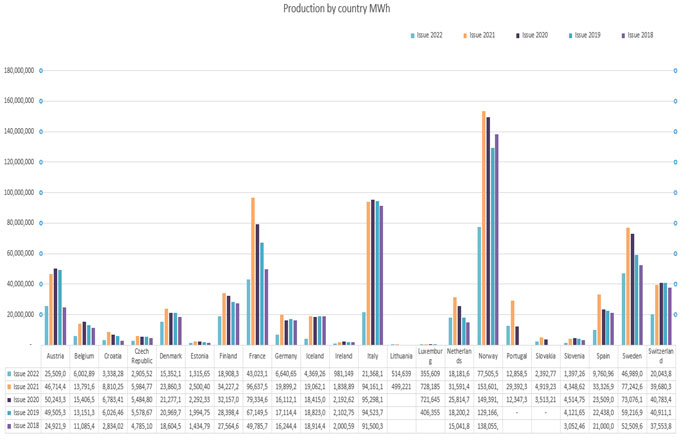
The AIB released the updated data for its members’ GO statistics as of July 2022 (included). This article provides you with a summary of the statistics. In the analysis, the information is related to the production side.

A persistent rise in production

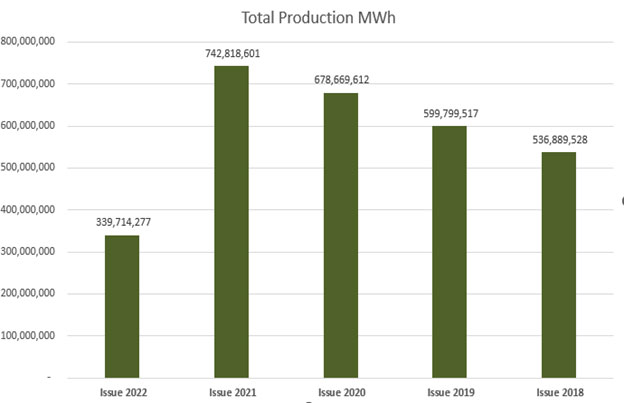
The growth of the Guarantees of Origin market doesn’t stop, and the data released so far are confirming the trend. According to AIB data, there was a 64 TWh rise in total production in 2021 over 2020. Compared to 679 TWh in 2020 and 600 TWh in 2019, there were more than 743 TWh of Renewable GOs issued in 2021. As a result, when compared to the year before, the number of GOs issued grew by 9.45% in 2021.

The main reason for this growth is the increase in AIB Hub member countries. While another reason is the growing number of countries that have decided to auction the Guarantees of Origin from plants that receive public subsidies, like France and Portugal.

The Nordic countries, France, and Italy are confirmed as the countries that issue the greatest number of Guarantees of Origin, while the following countries saw the biggest growth from 2020 to 2021: Portugal – 17 TWh, France – 17 TWh, and Spain – 9.8 TWh.

A stronger demand

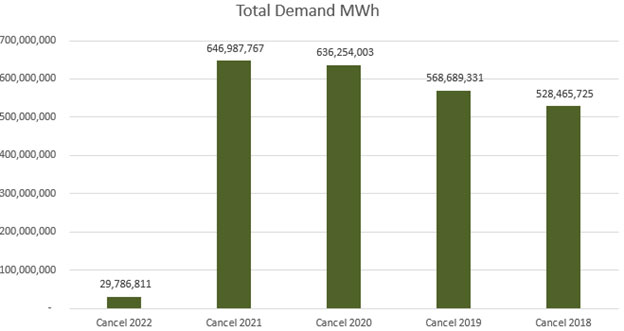
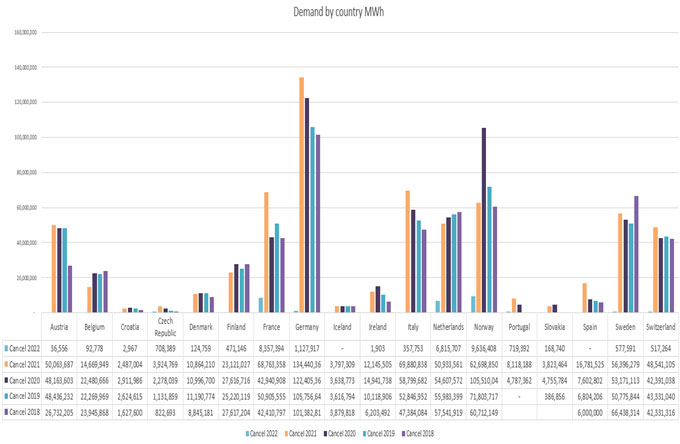
The AIB statistics also show an increase in the demand side, which is reflected by the number of Guarantees of Origin that are cancelled every year.  In fact, in 2021 the number of canceled Guarantees of Origin increased by 10 TWh, i.e. an increase of 1.7% compared to 2020.  The positive trend is confirmed along the years, passing from a total of 568 TWh of cancelled Guarantees of Origin in 2019, to 636 TWh in 2020 and finally to 646 TWh in 2021.

The biggest increase in the demand came from France, with 25.8 TWh more compared to 2020. Also in Germany and Italy the volume of Guarantees of Origin cancelled grew by respectively 12 TWh  and 11 TWh.

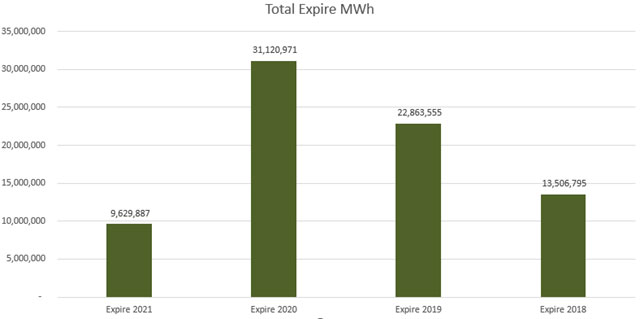
The number of expired Guarantees of Origin has declined over the past 4 years, confirming the solidity of the growth of this market.

In conclusion, according to the AIB statistics, both issued and canceled GOs hit a record level in 2021, confirming the growing trend in the renewable electricity market. A great step forward has been done by France, with the greatest increase. While it is too soon to assess 2022 performance, 2021 numbers on the demand side will probably grow even more, since the disclosure period for 2021 in Germany ends in December 2022.


Contact us


Continue reading

Swiss energy bill in 2023: bad, but not terrible

Energy bills are not rising in the same way in all European countries: the Swiss case.

Even with 90% of electricity produced by its hydroelectric and nuclear power plants, Switzerland is not protected from the rise in electricity prices in 2023. In some municipalities the impact is felt more than in others. The Federal Commission for Electricity (ElCom) quantified the average increase in electricity prices for 2023 at 27%.

Because of decreased natural gas supply as a result of the ongoing conflict in Europe, electricity prices in Switzerland are rising along with those in rest of Europe. But because hydropower and nuclear power make up the majority of its electricity, the price shock is less severe than in its neighbors’ nations.


Continue reading

Switzerland: in 2021 80% of the electricity consumed is renewable

In 2021 80% of the electricity consumed in Switzerland is renewable: this is the way!

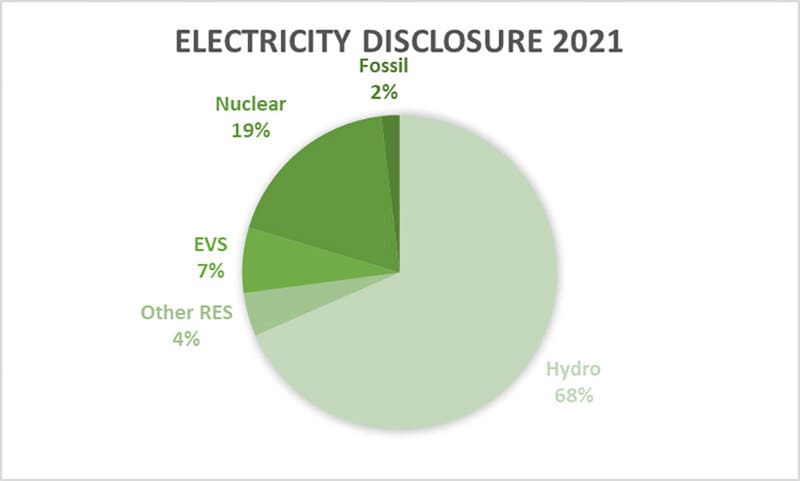
Yesterday the Federal Office for Energy published a press release communicating that about 80% (compared to 76% in 2020) of the electricity used in Switzerland in 2021 (mix distributed by suppliers based on electricity labeling) was generated from renewable sources. Most of it (68%) was generated from large hydroelectric plants and 11% each from photovoltaics, wind, small hydroelectric plants, and biomass. Only 19% of the energy came from nuclear sources, and only 2% from fossil fuels and waste.

Source: Pronovo

Switzerland is one of the few countries in Europe where since 2018 there is the full electricity disclosure. This means that “gray electricity,” or electricity of uncertain origin, is no longer allowed. This brought more awareness to the final consumers, preferring a higher percentage of renewables in their consumption mix. Furthermore, full disclosure has favored the use of Swiss Guarantees of Origin in the first place, while a smaller part of GOs has been imported from the European Union.

No Swiss GOs have been used in Europe because to date the Swiss Guarantees of Origin are no longer recognized in Europe for the purposes of electricity labeling pursuant to RED II.

Contact us


Continue reading

Stopping Russian gas: What should Bulgaria do now?

The Russian gas embargo is a retaliatory measure by Moscow against Bulgaria. Neutrality does not appear to safeguard against provocation. What should Bulgaria do now?

The decision by Moscow to shut off Russian gas supplies to Bulgaria puts the government’s ability to deal with a new crisis, as well as European unity, to the test. The Russian government made the decision when Bulgaria refused to pay for Russian gas in rubles, a requirement imposed by Russia in order to strengthen its currency, which had been weakened by sanctions related to the Ukraine conflict.

Bulgaria consumes roughly 3 billion cubic meters of gas each year, with 90% of it coming from Russia. Gazprom’s decision comes at the conclusion of the heating season, which is good news because district heating businesses are the country’s largest gas consumers – particularly in the capital, which consumes ⅓ of annual gas consumption.

The problem appears to be resolved in the short term – at least at first glance. The government has assured the people that it has expected such a move and has long been prepared for the possibility of Russia “turning off the tap”. According to Energy Minister Alexander Nikolov, deliveries to consumers are guaranteed for one month and will continue without a hitch. “We shall rely on the European solidarity agreement,” Bulgaria’s rulers stated.

What are the alternatives now?

Experts suggest buying large quantities of gas from large-scale Greek trading enterprises with access to Russian liquefied natural gas and Azerbaijani natural gas. Glass industries, fertilizer producers, and bakers are all stressed by the situation, as are municipal hospitals, kindergartens, and social homes, including more than 150 thousand gas-burning households.

Bulgaria will need to come up with a number of alternatives in the near future. These may include beginning to buy Azerbaijani gas and liquefied gas, and taking advantage of the EC’s offer to hold auctions and negotiate better prices.

The alternatives available to Bulgaria in the long run allow some freedom of choice for the country’s rulers. The IGB (gas interconnection with Greece) pipeline, expected to be operational by July, still appears to be the country’s trump card.

What does needs to be accomplished very quickly is completion of the first gas connection with Greece. The second priority is for the European Commission to begin negotiating for natural gas as a single consumer, because when the EC negotiates larger volumes, prices fall. The third point that must be agreed upon is acceleration of the construction of Greece’s liquefied gas terminal.

Another possibility would be to accelerate development of renewable energy sources. To speed up the bloc’s transition to clean energy and independence from Russia, the European Union (EU) is developing a proposal to loosen regulations on renewable energy projects. Under this plan, enterprises in the union will be able to develop wind and photovoltaic power facilities in specified locations without having to undergo environmental impact assessments, considerably speeding up the process.

Bulgaria has set a target of increasing the share of its electricity generated from renewable sources to over 30% by 2030. By then, the country’s renewable energy capacity will have increased by 2.6 GW, bringing it up to approximately 7 GW. Svoghe’s portfolio, which consists of five small hydropower plants along the Iskar River with a total installed capacity of 15.5MW, will contribute significantly to the nation’s efforts to achieve this goal, covering the electricity consumption of more than 20,000 Bulgarian homes and avoiding 35,000 metric tons of CO2 emissions.

AES Bulgaria is likewise pursuing this goal. It is studying potential construction of a combined 100 MW solar power and battery energy storage project, as well as a solo 80 MW battery storage project near Sofia, to support the electrical system. A memorandum of understanding (MoU) with the Ministry of Energy will allow research to be conducted for potential solar power and energy storage projects.

Improving energy efficiency and transitioning to renewable energy sources for power, heating, and cooling are critical to guaranteeing Bulgaria’s and Europe’s energy independence and mitigating climate change.

Contact us


Continue reading

Nvalue is proud to sponsor the 2022 Tennis Europa Cup European Final Girls 14 & under in Loano

Nvalue is very proud to sponsor the Europa Cup 2022. The European Championship will take place from the 1st  to the 3rd of July, with an opening ceremony on Thursday 30 June. The access will be free of charge.

The event is hosted by the Associazione Sportiva Dilettantistica Loano; his president, Mr Alberto Zizzini, is very much looking forward to opening this highlight of excellence in female youth tennis on Thursday.

At the end of the three day competition, the title of European U-14 category champion will be awarded, along with a qualifying place at the world championship.

The Europa Cup tournament is easily the largest girls/ladies/female? junior team tennis competition in Europe; created in 1990, the Tennis Europe Junior Tour has long been the platform of choice for the launch of a successful career, and in recent years has heralded the arrival of such top players as Justine Henin, Roger Federer, Caroline Wozniacki, Andy Murray, Victoria Azarenka, Jo-Wilfried Tsonga and Maria Sharapova, to name but a few.

Loano is a perfect location, located on the Italian west coast: an ancient castle, historical churches, and a gorgeous beach make Loano an alluring resort on the Italian Riviera. The town is situated mid-way between Genoa and Monaco and occupies a scenic spot below a ring of hills. Loano Tennis Club provides a central location with excellent facilities for players and visitors.

Nvalue is very pleased to promote a young professionals competition, because we believe in a greener environment in a more sportive world for all!


Continue reading

#stopwar #standtogether

We are deeply touched and concerned about the humanitarian emergency that the recent war is causing. Our thoughts and support are with the innocent people suffering from this conflict.

We are very thankful to our leader, founder and CEO Alessandro Faccoli, who in the past few days has worked to bring a Ukrainian mother with her two children through Poland to Switzerland, where he hosts them at his home.

Additionally, to support as many people as we can, Nvalue is currently donating to three Bulgarian associations that are working to help those who need it most in these terrifying weeks: Български Червен кръст / Bulgarian Red Cross, Kauzi.Bg and Gorata (https://gorata.bg/).

We share this information with the hope of inspiring others to take concrete action to help those in need.

#stopwar #standtogether


Continue reading

Our Director Marketing shares her vision with Platts on the current momentum of the GO market in Europe

Original Interview available on the S&P Global Platts.

Author Patricia Pinter
Editor Richard Rubin

European guarantees of origin prices reached all-time highs in 2021, driven by stronger demand and operators’ long-term commitments to renewable energy, leading to a deeper, more volatile market, according to Dania Piccioli, the director of marketing and communication at Swiss broker Nvalue.

“GOs are issued and cancelled on a yearly basis, so liquidity that used to be concentrated in the current-year contracts is spreading out towards future contracts,” Piccioli said in an interview with S&P Global Platts.

GOs prove to consumers that given quantities of energy were produced from renewable sources. In the EU, Norway and Switzerland, GOs are the only tool for end-users to trace sources of energy.

“Previously, most of the liquidity was seen in the current consumption year and the year-ahead [contracts],” said Piccioli, explaining the changes in the market profile. “Now, the entire curve, up to five years forward, saw increased liquidity, showing operators’ commitments to renewable energy and growing interest on locking supply on future contracts.”

A decade ago, when the market was immature, the fundamental demand for renewable energy certificates was driven by national mandatory schemes, Piccioli said.

“The usual trend was a higher price at the beginning of the year, and a very low price in March of the following year, because the market was very long,” she said. “In the last five years, however, we saw a stronger fundamental demand, closing the production-consumption gap. Increasing demand, together with a stronger liquidity, led to a more volatile market, with prices that can go up and down several times a year, recorded by a wide price range that goes from Eur0.30/MWh to Eur2.5/MWh within a five-year strip.”

According to S&P Global Platts pricing data, European GO prices reached record highs in 2021, with the benchmark Nordic Hydro 2021 contract pegged at Eur1.125/MWh on Oct. 1, a more-than-fourfold increase from January of that year. Platts data also shows that liquidity spanned across all technologies, with EU solar contracts showing a slight premium over hydro and wind contracts and EU biomass were a small discount over all other technologies.

Beyond standard European GO contracts, there are premium national markets pegged to levels above Eur10/MWh. For example, Swiss Naturemade and Dutch GOs.

“Consumers in Switzerland and the Netherlands prefer national production; that creates a natural premium for domestic GOs,” Piccioli said. “The size of that premium depends on the technology, the label and availability, but it can be very high.”

Regulations to boost demand

In regards to the GO market maturing in the next years, Piccioli said Europe should focus on demand development.

“The European Commission proposed as part of RED III (the EU’s Renewable Energy Directive) to allow any electricity operator to issue GOs, even if it enjoys public support,” she said.

Member states are also encouraged to issue GOs for non-renewable energy source to promote full disclosure, Piccioli said.

“These are fundamental steps to raise end-consumer awareness and increase voluntary demand for renewables,” she said.

Some countries are ahead of the European Commission proposal, notably the Netherlands, Switzerland, Austria and now France.

According to Piccioli, such full disclosure in Switzerland is contributing to the higher demand for national renewable production.

“As the consumer realizes what truly lies behind ‘non-defined’ [sources of generation] when consuming electricity, they understand that just because they live in a country full of water, that doesn’t mean they are actually consuming hydropower,” she said. “Thanks to the full consumption disclosure, the consumers have now the information to make a conscious choice when consuming renewable electricity. Transparency is very important for robust, functioning free markets so that fundamental buyers can forecast their procurement strategies to achieve their sustainability goals.”

Looking ahead five years, Piccioli expects GO markets to stay busy, with price level fluctuations and constant volatility likely to become the new normal, she said.

“This is thanks to both the growing voluntary commitment to consume renewable electricity, in particular through initiatives such as RE100 and the global carbon emission reduction objectives, such as FIT for 55 and Net Zero 2050,” Piccioli said.

Swiss exception

Still, Piccioli sees some challenges to an integrated European market.

“From July 2021, Swiss GOs were no longer accepted in Europe, even though Switzerland resides at the center of electricity transit between European countries,” she said. “This is due to political tensions that have nothing to do with the quality of the Swiss GO system and its compliance with European standards, the same goes with Brexit, leading to UK GOs no longer being accepted in Europe. Norway is also challenging the GO concept and evaluating the possibility to stop using GOs.”

In the overall context, however, the adoption of renewable energy certificates continues to grow in Europe and elsewhere, playing an important role in decarbonizing economies and driving countries into a more sustainable, greener future.

The recent explosion in European electricity and gas prices has exposed its dependence on imports, Piccioli said.

“It is becoming increasingly evident that investing in renewables is of crucial, strategic importance, not only for the climate, but also for the energy independency and socio-economic welfare of the European Union,” she said.


Continue reading

A chat with Steven Vanholme from EKOenergy, jurist, nature conservationist and climate activist

Thank you very much for accepting this interview with us. Can you briefly explain us what does EKOenergy do and what is your role inside of it?

Okay, so my name is Steven Vanholme, I’m originally from Belgium, but I’ve been living in Finland for the last 10 years, I’m an employee of the Finnish Association for Nature Conservation, and about 10 years ago I contributed to the starting of the EKOenergy project. My background is strongly in environmental organizations, I’ve been volunteering and working in Climate, Energy and Biodiversity for basically the last 25 years of my life.

EKOenergy is an international not-for-profit ecolabel for renewable energy. Moreover, the energy sold with the EKOenergy label fulfils additional sustainability criteria and finances projects that combat energy poverty. This way, the EKOenergy ecolabel brings additionality to renewable energy certificates such as Guarantees of Origin, RECs and I-RECs. The ecolabel proves that the consumed energy fulfils extra quality criteria, set by a network of environmental NGOs. Using the ecolabel also helps consumers make a concrete and additional impact through our Climate Fund and Environmental Fund.

In short, what is the role and the added value of EKOenergy into the Guarantees of Origin system?

We want to help and encourage consumers switch to renewables. We are to convince them to make this switch faster. Then obviously if they want to consume renewable energy, they will have to prove it somehow, and they will eventually need Guarantees of Origin for that.

Our added value can be idenfied with our action of taking a step further than just labelling renewable energy. In fact, as EKOenergy we have some criteria power plants need to meet, such as biodiversity criteria, the promotion of the energy transition worldwide,  the contribution to the Climate Fund and many others. Our role is not to focus too much on all the technical details, but to show that the switch to renewable energy is possible, that green energy is available and customers can take that extra step.

And what are, in your opinion, the main drivers why consumers choose you?

I think for the most part of large consumers the most important factor is additionality, since they want to do something more, someyhing extra than consuming 100% renewable electricity. Another main driver for us is that we are a non-profit organisation, and finally the fact that they can use our logo on their products and advertising. But honestly, there is no main reasons, but all reasons, included the flexibility we offer and the strict quality criteria we stick to, are equally important.

So, how can EKOenergy contribute to the achievement of the Net Zero goal?

Renewables represent a crucial step in achieving a carbon neutral society, and ultimately in the fight against climate change. The first thing we all have to do is to get rid of all fossil fuels. The more renewable there is, the more it becomes mainstream, the less fossil fuels we will need. All the people choosing renewable energy and working in this sector are squeezing fossil fuels out of the market. Even though this process is not going fast enough, that’s our contribution to a zero carbon world. As we always say, we should not wait for the 2050 and 2030 targets, everyone can switch to renewable energy now.

What would you answer to those who believe that GoOs are a means of greenwashing?

It’s very simple. GoOs are a powerful tool to prove renewable energy consumption and, in order to contribute to the fight of climate change and join the energy transition, people and organisations must switch to renewable energy. Guarantees of Origin are a neutral tool per se, what’s important is how to use them correctly. For example, by consuming renewables guaranteed by an eco-label as ours, consumers can have an additional reassurance in terms of the quality of the energy they consume.

The truth is that people still rely heavily on gas and I agree that Guarantees of Origin are not enough alone to solve climate change, but not taking an initial step just because it’s not enaugh doesn’t make sense either. Our goal as EKOenergy is to inform consumers and help them understand that even through simple steps they can offer a great contribution, and that’s what really counts.

What is the future of Guarantees of Origin and where do you see them in 5 to 10 years from now?

That’s a difficult to say. As long as there is interest in knowing the origin of the electricity and the energy consumed, you will need a tracking system, and I’m sure that in 5 to 10 years, the origin of the electricity will still be very important, and people will still have specific requests concerning local consume, energy type and so on. Obviously, I hope that there will be much more that one can do in terms of turning green, but as long as keeping track of the origin of electricity we consume and the condition and standards of the plants producing it will be relevant, GoOs will still be part of the ecosystem.

In the race to Net Zero, what do you think could be a true game changer?

You know, we don’t have to wait for the game changer. Everything we need is there, the game changer is already in our hands. The key is how to use it: people need to understand that the time of fossils is over, that fossils are killing us and we should not switch to renewables in 2030, we have to do it now and massively.

Finally, what are your goals as EKOenergy for 2022?

Well, we hope that we can continue on our path of growth and to reach out to larger and larger consumers, to gain more licenses, more partners, more consumers, more projects. And then, on a largest scale, also to see that our work inspires many others to switch to renewable energy and to enter the business, because the transition, as I said, is not going fast enough, and we need more actors such as EKOenergy and Nvalue on the field.

Go visit EKOenergy website here.


Continue reading

Dania Piccioli, our Director Marketing and Communication, answers Qui est vert?

We have started the year by an interesting chat with Qui est vert? regarding the promotion of the energy transition. Check out the original interview here.

Here below we have translated it in English, enjoy the reading!

QuiEstVert gives the floor to its members!

Dania Piccioli, Marketing and Communication Director at Nvalue, answers our questions and gives us her vision of the energy transition of the European electricity mix.

Since 2008, Nvalue has positioned itself as a supplier of electricity from renewable sources through the marketing of Energy Attribute Certificates.

What place does the energy transition occupy in the fight against global warming?

The energy transition occupies a very important place in the fight against global warming. Firstly in terms of production: it is crucial to move towards production from renewable sources.

“The energy transition requires sustainable consumption in line with our resources […]”

However, what remains even more crucial in my opinion is that the energy transition goes through consumption: we must at all costs stop or change consumption habits that have an impact on our climate. This will necessarily involve efforts to optimize, but above all to reduce our consumption: energy optimization of buildings, heating, and travel habits, etc.

What is needed above all today is to adopt energy consumption that is sustainable and in line with the resources that are available today and that must still be available tomorrow.

What is your opinion on the situation of France in relation to the energy transition precisely?

Not being French, I will give an opinion with an outside eye.

France, like some of its European neighbors, is a geographically sprawling country with a rich history. In fact, there are a multitude of issues to consider. Among them, the production of electricity which depends mainly on nuclear energy. This distorts the perception of French consumers who do not necessarily feel concerned by electrical pollution… Which makes the subject all the more complex!

Nevertheless, I think that France could do much more in terms of infrastructure, communication and information with regard to energy efficiency and the reduction of consumption.

Let’s remember, however, that there are things that are being put in place. I am thinking in particular of the full production disclosure, which was recently adopted. It might be a matter of time before the full consumption disclosure will be also implemented.

What is your feeling about the government’s policy on this subject?

There are many interests at stake, therefore It is not that simple. If the government forces too much on one side – I mean here in favor of renewable energies, many actors will be impacted on the other (in employment, economic issues) …

So it seems complicated to me to be too radical and to consider changing everything overnight. On the other hand, I think that we have to confront and manage to reconcile all the interest groups… While implementing long-term solutions.

“[…] I think that we need a real incentive from the State, and full consumer disclosure is a very good tool to achieve this. »

In Switzerland, for example, we have set ourselves a total shutdown of nuclear power by 2050. In addition, the Swiss State has introduced the full consumption disclosure: the obligation for suppliers to transparently communicate to their clients the entire mix of energies that forms the electricity supply. For me, this is a very good thing since it helps consumers understand what they are really consuming, while showing them the benefits of consuming electricity from renewable sources.

Clearly, even if this requires complex reflections, I think that a real incentive from the State is needed, and full consumption disclosure is a very good tool to achieve this.

What can a French consumer who wants to act for the energy transition do?

To choose. Whatever the action (for electricity consumption, travel, etc.), choices must be made consciously. However, to choose well, information and knowledge is key…

In your opinion, are consumers sufficiently informed about their options?

Clearly not. This is an extremely complex and vast subject. I notice it as soon as I talk about my profession: the sector is generally very poorly understood, and as soon as we mention the question of Guarantees of Origin, I myself realize that it is a difficult concept to explain.

“The concept of the Guarantee of Origin is difficult to explain. »

To top it all off, before understanding all these topics, you must first understand the functioning (physical and legal) of the European electricity network.

For all these reasons, I think we have to start by stopping misinformation, then start a lot of educational work.

What to say to people who position themselves against the development of renewable energies (EnR)?

I would advise them to go to Beijing (or any other ultra-polluted megalopolis), and breathe the ambient air there. It should be easy to very quickly realize the difference in air quality and understand the interest of acting on our CO2 emissions.

Beyond any ideological question, we cannot deny the obvious.

Through what actions is NValue committed to the energy transition?

Since 2008, Nvalue has worked 100% in favor of the energy transition. In 13 years, we have witnessed the growth of the awareness towards the renewable energies and the development of the market.

On the supply side, we offer many services:

  • We promote the consumption of green electricity through the Guarantees of Origin;
  • We have increased the number of our services over the years and have diversified our customer portfolio, addressing both suppliers and end consumers;
  • We also help customers in each of their steps: understanding the market, reducing CO2 emissions, implementing the market, etc. ;
  • We have developed an offer around renewable gas, an offer that we are developing;
  • Finally, we offer carbon-offset certificates.

In addition, last year we carried out our very first carbon assessment, which enabled us to put in place a certain number of abatement measures with our employees: promotion of the home office, optimization of travel, reduction of the consumption of energy, sponsorship of beehives…

Are there any developments, new products or services coming to Nvalue in the coming months/years?

Above all, we focus on innovation and the expansion of our international business: for the future, we want to increase our visibility and our presence in new markets.

We also cooperate with many labels to promote electricity from producers in line with our values.

And finally, we work to promote consumption on a monthly basis to European customers (and not just France  ).

The final word ?

We must choose and act!

Contact us


Continue reading

Accelerating the energy transition is the only way to reach the 1.5°C climate target

The COP26 meeting in Glasgow has recently concluded, and the issue now is whether the target of maximum global warming of 1.5°C can still be met. The Federal Council presented a model calculation conducted by the Federal Laboratory for Materials Testing and Research that illustrates how the energy transition may result in the lowest cumulative emissions feasible. Instead of gradually reducing emissions, we should accelerate the transition to solar energy and operate fossil power plants at full capacity for one last time.

Theoretically, according to Empa, by speeding the transition in this way, it is still feasible to lower the likelihood of exceeding the 1.5°C climate target to less than 50%.

The Empa study assessed numerous scenarios and came to a definite conclusion: using all fossil-fuel power plants to their full capacity and investing the extra energy in creating the solar machine would be the most efficient way to action the energy transition. This entails that, surprisingly, fossil emissions may grow by up to 40% throughout the transition, but only for the purpose of creating solar infrastructure. As a consequence, the energy shift might be accomplished in five years, resulting in the lowest total emissions. After then, the fossil engine may be turned off. However, even the most rapid energy transition has a 20% risk of surpassing the 1.5°C threshold, and it could not be possible to go any lower than that.

But the importance of the energy transition in order to reach the 1.5°C is clear, according to the International Renewable Energy Agency, to meet CO2 reduction targets by 2050 a series of essential technology and innovation to accelerate the energy transition and achieve a better carbon management; supportive governmental policies to assure the active participation of both public and private actors to the transition; related job development and socioeconomic benefits; and international cooperation to ensure energy supply and access factors need to be aligned to this goal: technology and innovation are needed to accelerate the energy transition and achieve a better carbon management; supportive governmental policies appear to be the only means to assure the active participation of both public and private actors to the transition; related job development and socioeconomic benefits will secure the continuing of this international effort, and, of course, international cooperation will be key to ensure energy supply and access.

IRENA released a report in June 2021 named The World Energy Transitions Outlook, which lays forth a plan for the world to meet the Paris Agreement targets and slow the rate of climate change by restructuring the global energy landscape.

The report in question can be summarized around five key findings:

  • Proven solutions for a net-zero energy system are widely available today. Renewable energy, green hydrogen, and advanced bioenergy will lead the future energy landscape.
  • To stay on a 1.5°C climatic path, a blend of technologies will be needed. These include increased energy efficiency to ensure economic growth, decarbonised power systems dominated by renewables, increased use of electricity in buildings, industry, and transportation to aid decarbonisation, expanded production and use of green hydrogen, synthetic fuels and feedstocks, and targeted use of sustainably sourced biomass.
  • Financial markets and investors are facilitating the energetic shift by redirecting their funds and capitals from fossil fuels towards other energy solutions, including renewables.
  • Energy transition investment will need to grow by 30% beyond anticipated investment to a total of 131 trillion dollars from now to 2050, amounting to 4.4 trillion dollars per year on average.
  • Socioeconomic policies will be critical in achieving the energy transition at the necessary rate to limit global warming to 1.5°C.

To conclude, a new global energy system needs to be built and the way appeared already quite clear before COP26: funds, investments and regulations will be key to this transformation, but, most of all, serious intentions and concrete actions from governmental institutions will determine this shift, and the possibility to limit the damage caused by climate change.

At Nvalue, we offer a wide range of market-based solutions to meet our customers’ environmental goals when it comes to renewable energy consumption, energy efficiency targets, renewable electricity, gas products, emissions reduction and neutralization.
Learn more about our climate solutions and services on our website and feel free to contact our experts to get advisory on what you can do to participate in the energy transition!


Contact us


Continue reading

Ahead of COP26. What is it and what can you do in the transition to net zero emissions

The United Nations Climate Change Conference (COP26) will take place in 2021, and it will be a milestone point in the fight against climate change. COPs, which stand for ‘Conference of the Parties,’ brings practically every country on the planet together for global climate summits. The 26th annual summit will be held in Glasgow this year from October 31st to November 12th.

As last year’s COP summit was canceled due to the Covid-19 emergency, this year’s event is to be the most significant UN Climate Change Conference to take place since the landmark Paris Agreement was adopted in 2015. This year’s summit, in fact, marks the first deadline for the updated national contributions of the countries participating since the Paris Agreement. The COP26 also represents an important opportunity for governments to review their commitments and collectively strengthen their ambition.

The goal of this COP is to build on the momentum generated by diverse sectors of society and to achieve quick, substantial, and proportionate reductions in all greenhouse gas emissions in a fair transition encompassing all actors.  All of this must be accomplished while both conserving and recovering environment, as well as assisting vulnerable people and nations that are not prepared to deal with the effects of climate change. To maintain global warming to 1.5 degrees Celsius, urgent action and efforts are needed. The report of the IPCC shows that we might have already irrevocably changed the planet, and many escalating extreme weather occurrences may be traced back to climate change, such as the flooding in China, India, Europe, and the Philippines, as well as record-breaking hot waves in the Middle East, Canada, and the Mediterranean. According to the September UNFCCC NDC Synthesis Report, we are on a road to 2.7°C global warming, and emissions will keep growing by 2030 compared to 2010 levels.

Governments will gather, as they have in previous COPs, to consider what regulations and mechanisms needs to be put in place to make the Paris Agreement operative. Moreover, countries are required to submit updated nationally determined contributions (NDCs) by the end of 2021, which will establish higher levels of ambition for achieving emission reduction targets in their respective countries. This is likely to lead to more stringent national legislation requiring businesses to decrease their emissions too. Since having decided to host COP26, the UK government stood one step ahead of the game and launched the Race to Zero campaign, which urges firms to commit to a 68% emission reduction by 2030. For this reason, COP26 might mark the beginning of a greater and more urgent involvement of the private sector, as well as continuing to emphasize and encourage maximum involvement by government and public sector actors.

The keypoints of COP26

It will be a chance to fully utilize the COPs’ mobilizing capacity to promote a whole-of-society approach to combating climate change and its harmful consequences. The new COP26 presidency team has a once-in-a-lifetime chance to make a significant difference in this broader involvement by:

  • Strengthening the Marrakech Partnership for Global Climate Action (MPGCA), as a catalytic space within the UNFCCC.
  • Expanding engagement of non-State and subnational actors, reflected in the number of institutions engaged, their geographic diversity, their constituency diversity.
  • Greater focus on sector-specific decarbonization through alignment of goals, and collaboration between Parties and other actors.
  • Help guarantee that efforts in both the voluntary and compliance market complement and mutually support each other to meet the goals of Paris. Both Parties and non-state actors should strive to limit the proliferation of non-comparable markets and approaches.
  • Expanding focus on the role that the finance sector can and must play in support of the Paris goals.

COP26 marks also a critical moment for the international community to agree on key outstanding and pending issues related to the implementation of the Paris Agreement.  In particular with regards to Article 6, the framework for governments and the private sector to assess and trade emission reductions, it will almost certainly be given a strong set of rules, paving the way for a fully global carbon market. This might increase global demand for climate solutions and provide companies that have already committed to a bold climate strategy a consistent advantage if compared to those that are just now about to define their environmental commitment or will soon find themselves obliged to do so.

We accompany your business in the transition to net zero emissions

Those companies who take bold climate action will be at the forefront of altering the way we conduct business. To these businesses sustainability is more than simply a good investment. Disposing of a consistent and integrated climate strategy also means having a strategic differentiator that leads to better financial results and more adaptability to external shocks.

There are actions your organization can take to increase its sustainability strategy:

  • Measure your footprint by understanding carbon emissions, analyzing product related impacts and evaluating climate-based approaches and solutions.
  • Set your preferences and targets through the deep understanding of your climate ambitions and get competent advisory on how best to achieve your targets.
  • Reduce your footprint through renewable energy and renewable gas consumption, energy efficiency solutions and supply chain decarbonization.
  • Neutralize and compensate your residual emissions through carbon offsets and carbon removals.

Learn more about our climate solutions and services and feel free to contact us to get advisory on what you can do about your climate strategy ahead of COP26!


Continue reading

A chat with Surya Jaikaran, Business Development Executive

When did your journey in the energy field start and how?

After I graduated from the university, I started straight away in the energy business in oil and gas because back then that was kind of a prestigious industry to be in. Since I have a major in piping design, I was doing an internship to design piping routes on offshore platforms. So that’s basically where my journey in the energy field started. From the energy sector I never left. I just went to a different direction which was more ethically suited for me. This new field of sustainable energy fitted me better due to my passion for the environment. My passion for the environment started at a young age where I got myself involved doing volunteering in the environmental and humanitarian sector. This is something that I am still very passionate about and try to incorporate this in my lifestyle. In my spare time, if possible, I would be involved in environmental projects.

And how did you get in touch with Nvalue?

I was looking for sustainability jobs and environmental jobs in general, not in particular at a certain location or a certain place, and I found the position available at Nvalue. I went into the company’s website and I was very intrigued by what they were doing, by the entire journey that they’ve been through so far, in particular in the carbon offsetting market, which is something very important in the market right now, and that’s what convinced to apply for the Business Development Executive position.

So what are your tasks and which are the challenges of your job as Business Development Executive for Corporate Clients?

My role within Nvalue consists in getting in contact with clients, approach companies and see what their sustainability and climate strategies in the country they are living in are, and see if and where we can help them in their journey to meet their targets. Same way, I help small and medium companies who have not identified a sustainability or climate strategy yet, to set effective and reachable climate goals towards net zero, and I assist them with the implementation of that strategy. Here, together with the internal efforts to reduce their GHG emissions, I assist them with the procurement of the necessary market based solutions to mitigate the residual emissions, such as Energy Attribute Certificates and Verified Emission Reduction units.

Dealing with companies operating in various industrial sectors, comes with a challenging part which is, having to know a little bit of everything and process a large amount of information to provide an excellent service.

What kind of opportunities do you think Nvalue could seize with your help?

As my professional experience includes both involvement in environmental projects and the commercial development of projects related to renewable energy and carbon offsets, I believe I can provide a unique combination. My background allows me to critically evaluate carbon offsets projects, and select those that best coincide with the preferences of my clients. Since I’ve been doing business development since a long time, I think that’s also a little bit where my strength is, in engaging with people and with clients and portraying a message.

Basing on what you see every day in your job, what counts the most for international corporations when it comes to climate emissions?

I believe that the most challenging aspect for corporations is to understand the different options, solutions, market based instruments and reporting standards that are available in the market and in the actual regulatory framework, in order to reduce the environmental impact and make net zero claims.

Which are the challenges you and your clients are facing every day?

The most common problems that this market is facing at this moment is greenwashing.
Greenwashing happens when companies make public claims to be fully green and climate neutral in order to divert attention from the real harmful environmental impact of their business activities.
At Nvalue we pay close attention in selecting our partners and advising our customers, always giving priority to the implementation of concrete measures to reduce their environmental impact, and afterwards providing those market based solutions to fully achieve the set objectives.

Last but not least, what keeps you motivated in doing what you do and carrying on the work you are doing?

We are fighting climate change! Together with companies that work with us and together with Nvalue, I feel like I am doing something that is good for the environment, for our society, and for the planet. I strongly believe that one needs to have a passion for the environment to work in this business, if not, this could be the wrong place to be, as motivation and belief in what you do are key in climate markets.


Continue reading

Formula E as the first global sport to be certified with a net zero carbon footprint

In 2011 FIA President Jean Todt and Formula E Chairman Alejandro Agag came up with the idea of an all-electric street racing series. After only six seasons of racing on the streets of some of the most progressive cities of the world, Formula E gained World Championship status. In 2018, the ABB FIA Formula E Championship became the first category in motorsport to be awarded with ISO 20121 certification, certifying event management best practices in terms of social and environmental impact. This year, the ABB FIA Formula E Championship maintained its status as the only racing series to achieve third-party ISO 20121 accreditation, ensuring to set once again the international benchmark for event sustainability.

Formula E’s approach to sustainable management

While the aim of an all-electric street racing was redesigning the concept of the car race, maintaining a sport that the world is fond of, but reducing its environmental impact and making it sustainable, Formula E is making an extra effort. In fact, it stands out for applying a comprehensive approach to sustainable management, aiming at leaving a positive impact for future generations, and to community engagement projects ensuring social inclusivity and economic growth.

Since the major source of emissions concerns traveling and transportation, the Formula E calendar is subject to an optimization, allowing Formula E’s management to limit air traveling and save up to 15000 t CO2-eq every season, which is comparable to the yearly emissions of 1500 European residences (fiaformulae.com).

The ABB FIA Formula E Championship has one of the smallest carbon footprints within major sporting events, corresponding to 86kg of CO2 per spectator, which represents the equivalent of driving 400 kilometers in a car (fiaformulae.com).
On-site waste has been reduced by cutting out single-use plastics, and adding reusable water bags and refreshment points, saving a total of 200,000 plastic bottles and 10km of non-PVC recyclable trackside branding (fiaformulae.com).

This will not only allow to compensate GHG emissions, but also help the local economies and communities close to race locations, resulting in a larger, positive effect. These unavoidable emissions from the previous six seasons have now.

Sustainability is a priority of several world sports championships

The Roland Garros French Open, the 2016 Olympics in Rio de Janeiro, and the 2016 UEFA European Championships in France are among the few other sport events that have been awarded with the ISO 20121 accreditation.

Inspired by Formula E’s initiatives, Formula 1 is also planning on cutting emissions and adhering to sustainability measures. In November 2019, F1 announced an ambitious sustainability plan to reach a net-zero carbon footprint by 2030.

Nvalue’s commitment towards sustainable events

Since 2021 Nvalue is partnering up with Stagend.com, an online platform that helps event organizers to book all sort of entertainers, to make all live shows powered by 100% renewable electricity.

The cultural and entertainment sectors have long been trying to find ways to reduce the environmental impact of events. The forced pause imposed by the pandemic allowed Stagend.com and Nvalue to reflect together on concrete action to restart in a more conscious and sustainable way.


Continue reading

Urban forests might play a key role in the fight against climate change

Cities continue to grow in population and the number of individuals living in urban areas keeps rising unceasingly. Together with the population, pollution and resource exploitation are also growing, which puts sustainability at the heart of the future development of large urban centers. Combating pollution and reducing the overall environmental impact of big cities is vital when planning metropolitan upgrading measures. Urban forestation programs bring green back to cities, reduce pollution, and improve city dwellers’ quality of life, while defending biodiversity of metropolitan areas, and it may become a true and proper route to sustainable growth.

The term “urban forestation” refers to the planning and development of new and existing green urban and suburban areas, making nature a protagonist in this landscape. There are numerous options for increasing green spaces: for example, it is possible to create public or private metropolitan woods, vegetable gardens, tree-lined streets, public parks, as well as green roofs and facades. Creating green and flowery areas also allows the bees to be brought back to the city, which play a fundamental role in the prosperity of the flora.

However, no such project could reach its goal without scalability and a systematic and well-planned long-term programming to minimize urban emissions and dramatically improve residents’ quality of life.

According to a report by the UN’s International Resource Panel, which is part of the UN’s Environment Program (Unep), by 2050, up to 2.5 billion people will have moved to cities, resulting in a 125% increase in natural resource usage. We cannot ignore the reality that a metropolitan area contains resources and energy, which are eventually returned to the environment as waste, pollution, and land consumption. Even though they only account for a few percentage points of the global area, they are responsible for more than 70% of greenhouse gas emissions, 60% of energy consumption (ESPAS), and local temperature rises due to the urban heat island effect. The closer to urban centers, the more vegetation cover decreases and soil sealing increases, causing urban forests to become critical to the protection of urban soils and the associated biodiversity. Urban forests, in fact, store nearly as much carbon per hectare (178 tonnes C per ha) as tropical forests (190 tonnes C per ha), indicating that their contribution to carbon storage is significant (Wilkes et al., 2018).

Many governments and municipalities are already recognizing the importance of this issue and are mobilizing in order to develop effective plans and policies for urban development. In fact, there are programs and bands predisposed to finance and incentivize urban forestation projects, demonstrating how crucial it is now to promote such initiatives.

Urban reforestation is happening!

UrbanShift is a GEF-funded program based in Washington DC helping more than 20 communities in Asia, Africa, and Latin America embrace integrated urban development approaches, resulting in more efficient, resilient, and inclusive urban areas. Their planning methods go across traditional municipal sectors and take advantage of the many benefits that nature-based solutions and the circular economy have to offer. They also support progressive land use, low-carbon transportation, and community-focused projects in order to reach the goal of healthier communities, valued and protected ecosystems and neutralized carbon emissions.

Forestami is a Europeanproject promoted by the Metropolitan City of Milan in collaboration with the Municipality and the Lombardy Region, which provides for the planting of 3 million trees by 2030, aimed at cleaning the air and reducing GHG emissions while improving dwellers’ wellbeing. Apart from the relevant contribution of the main promoters, the project actively encourages private citizens to freely donate for the upgrading and the reforestation of their neighborhoods by raising awareness and financially supporting the planting of a number of trees.


Continue reading

Alessandro Faccoli elected CEO of Nvalue AG

Press Release

16.07.2021, Wollerau

The search for the challenging position as CEO of Nvalue AG and for Fabio Mancin’s successor has been successfully concluded with the election of Alessandro Faccoli.

The Board of Directors of Nvalue AG is thus relying on continuity and experience. Alessandro Faccoli is the founder of Nvalue AG and, together with his team, will ensure the long-term success of Nvalue AG by consistently investing in new, future-oriented activities while at the same time maintaining the strong core business of Nvalue AG.

With a lot of passion, Alessandro Faccoli will continue to do his utmost to offer customers an excellent service. Alessandro Faccoli is very much looking forward to his new tasks and is convinced: “Together we will continue to write the success story of Nvalue AG”.

Contact Press
Dania Piccioli-Cappelli
Nvalue AG
Director Marketing and Communication
+41 44 508 75 95
dania.piccioli@nvalue.ch


Continue reading

A chat with an expert of the energy market: Christopher Stahel

When did your journey in the energy market start, and how did you get in touch with Nvalue?

My journey started quite a long time ago, in the 90s, when I started studying environmental engineering and encountered this industry. Afterwards, I started working for Energieforum Schweiz, a company located in Bern that worked in energy policies and was involved in the discussions with the parliament regarding opening the electricity market in Switzerland. That one was a good start for me, even though I always enjoyed more the business side of it, rather than the political one. This is the reason that led me to move to atel in Olten, where I started working in business development and got to know Alessandro Faccoli and Fabio Mancin. That was 15 years ago! After I left, I joined the gas industry and started working for Energie 360°, one of the biggest gas utilities in Switzerland. Then, after another two years, I left the company and founded my own. I met Fabio Mancin again a few months ago through a mutual client, and that is how we decided to start cooperating.

You started your career in traditional energy and gas markets, have you always wanted to end up working in renewable energy or was it something that came naturally along the way?

Ten years ago, I was not involved in renewable energy, and during my time in Olten we did business development in power, coal, oil and gas, but not in renewable energy. Then I entered the gas industry and realized that a change was needed in the industry, and therefore I came back to where I started by studying environmental engineering and focused again on renewable, like a circle that comes together in the end.

It’s been a few months now that you’ve been collaborating with Nvalue, what do you like the most about the company?

Nvalue is completely different from other similar companies in the field. I think it has exactly what the market needs right now: the speed and the ability to identify opportunities and seizing them by a fast decision process.  Once I get to know it more closely I appreciated the great professionalism, but most of all I was positively surprised by its team, especially the one in Varna, that is very knowledgeable also in the Swiss market. This is not so common and it means that the internal information flow and training are aspects that are well cared for and that work well. In addition, I was impressed by the motivation that the team has, especially in younger employees. This is something that we rarely see from Swiss young people, as they grow in a privileged environment, while Nvalue’s employees really believe in what they do and feel as pioneers in the market, which, I think, is what keeps motivating them. In this sense, the international approach that Nvalue has is definitely a strength in terms of freshness and motivation. Also, the company does not have a complicated organizational structure and decisions are taken in a very fast and simple way. Before I started the cooperation with Nvalue, I asked some friends in the market if they knew the company, and they all answered that it was a good name, with a lot of experience, fast responding and always available. I would define Nvalue as a very customer-oriented company, which is something that is very different from the classical gas utility: this flexibility is something that the actors in the market look for and would like to imitate.

Which opportunities do you think Nvalue could seize with your help?

I think that with my help the company will gain a deeper understanding of the customers’ needs, while creating new products and alliances in the gas industry, thus allowing scaling up the size of the business. The importance of such new alliances is something I have been very committed to during the last five years and is definitely one of my main goals and objectives also in Nvalue.

From your experience and daily activities, which are the perceptions that customers currently have on the green gas market and what are their expectations?

My impression is that while in the past many believed that green economy and renewables were just a temporary hype, now they realized that this is something that is here to stay, also due to the global climate discussion and the recurring votes on these topics. It is now more clear to the market players that a company or a utility do not have the privilege of a choice anymore, a change in the way of doing business is needed. What our customers need right now are the means, competences, network and strategy to go in this direction, and we are here to help them, while also contributing to the development of this market.

Thank you very much for sharing some of your experience with us. To conclude, what motivates you to keep working in renewable energy and natural gas, and do you see your career proceeding this way?

Absolutely, it could sound as an “utopian” affirmation, but I believe that we can make the difference and actively create our future by having a concrete impact on it. We are already seeing that the old economy is now changing its way of doing business and personally I want to be part of this change. In the last twenty years, while working in the energy sector, I realized that we can make things happen with our doing, and that’s why I never liked just performing regular routinely administration. I like to take an active part, to try new ideas and also be ready sometimes to fail, because failure is necessary to learn and grow. In the gas industry, big utilities often take no risks, but a change of paradigm is necessary, it must be allowed to fail and take some risks, especially when speaking of the green transition, because the way has still to be paved for this sector, and uncertainties come along with the lack of experience. However, if you stay still and do not face uncertainty, you will not be able to seize opportunities either, and the hidden risk behind immobility, is to miss progress and innovation.


Continue reading

On the 13th of June, the Swiss population rejected the revised CO2 legislation, preventing more ambitious climate goals.

Fridays for the future, 2019, Mika Baumeister

The revision of Swiss CO2 legislation was denied in a referendum on Sunday: Swiss electors rejected additional emission-reduction measures in the context of a more ambitious climate policy, aimed at assisting Switzerland in meeting its carbon emission targets in accordance with the Paris Agreement. After three years of debate in Parliament and a widely reported campaign both in the economic and environmental worlds, the draft of the new CO2 law – considered one of the cornerstones of Swiss climate policy – was rejected by 51.6% of voters, with total participation of 58.9% in the vote. A result that comes as a bit of a surprise when you consider the polls’ forecasts. The vote of rural Cantons was crucial to this result.

The concerns that have compelled a large portion of the electorate to vote no are mainly of a financial nature, focusing on the economic impact that the new CO2 legislation would have had, particularly for the middle class, which is already under fiscal pressure. Furthermore, the concurrent vote on the two agrarian initiatives has additionally obscured the issue of climate protection.

The revision of the CO2 legislation in a nutshell

The goal of the new CO2 law was to halve emissions, compared to 1990 levels, in order to comply with the commitments made by signing the Paris Agreement. The key principle upon which it laid was the ‘polluter pays’ one, with a redistribution to the population and businesses of most of the taxes collected.

Aside from emission reduction goals, the new CO2 legislation included, among other things, a tax on airline tickets (ranging from 30 to 120 Francs), an increase in the CO2 tax (to 210 CHF/tCO2), a rise in the price of fuel up to 10 cents per liter (12 by 2025), and the preservation of the obligation for fossil fuels importers to offset their CO2 emissions. Finally, the proposed legislation included a number of other requirements, such as the rehabilitation and heating of buildings, as well as the establishment of a climate fund.

The Referendary Committee

The new CO2 legislation was approved by the federal legislature in September of 2020, with only the SVP – Swiss People’s Party – objecting. Following that, a referendum was requested by two distinct committees: one composed of representatives from the automobile, transportation, aviation, petroleum industries, and politics, which raised serious concerns about the risk of more bureaucracy, bans, and, most importantly, new taxes; and the other composed of environmentalists who believe that the current law is not sufficiently effective in the fight against global warming and climate change. In total, the two commissions collected 72,622 valid signatures on a minimum of 50,000 to hold a federal referendum.

The consequences of the no

Following the rejection of the new legislation, Switzerland will no longer have a national climate target beyond 2021, despite the fact that the international target to reduce greenhouse gas emissions by 50% by 2030 compared to the levels of 1990, adopted with the ratification of the Paris Agreement, remains valid.

Secondly, with the current law, the CO2 tax is set at a maximum of 120 francs per ton of CO2, while with the revision, the government could have been able to increase the tax to 210 francs. This will likely lead to a lack of funding for climate projects.

In addition to this, without further political intervention, the exemptions from the CO2 tax currently in force for companies operating in specific sectors and committed to reducing their emissions will no longer be possible starting from January 2022, as the extension of these will not be prolonged.

Finally, with the rejection of the new law and, consequently, of the reduction target by 2030 contained therein, the foundations for renewing the obligation for fuel importers to offset CO2 emissions will be missing, and importers will no more need to invest in climate protection projects starting from January 1st 2022.

Climate change protest demonstration strike in 2019, Markus Spiske

Achieving climate goals through market mechanisms

The Swiss climate strategy aims to achieve net zero emissions by 2050, according to the Federal Council decision of August 2019. The revision of the CO2 law was an important part of this strategy. The result of this vote shows the discontent of the population with respect to a strategy to combat climate change that entails new taxes for citizens.

In fact, financial incentives play a fundamental role in the implementation of the pillars of the Federal Council’s 2050 energy policy, two of which are based on promoting the production and consumption of renewable energy and reducing energy consumption. In particular, the “Buildings Program” provides that part of the funding comes from the CO2 tax, which, with the revision of the Law, should have gone from 120 CHF / tCO2 to 210 CHF / tCO2. With the non-approval of the new legislation, this will no longer be possible, and alternative methods will have to be found to finance all the interventions necessary to achieve the climate objectives.

Could this be an opportunity to review the political approach to financing the climate transition, and consider alternative tools for achieving emission reduction targets? The answer could be yes. In fact, there are systems based on market mechanisms, where instead of aiming for a generalized reduction in emissions through tax increases, clear objectives are allocated to key operators in each sector, allowing them to choose the most economically advantageous way to achieve them.

In the European context (which also includes Switzerland), the market mechanism in force for the generalized abatement of CO2 emissions is the European Emission Trading Scheme. In addition to this, some countries use market mechanisms to promote energy efficiency and renewable energy consumption.

White certificates

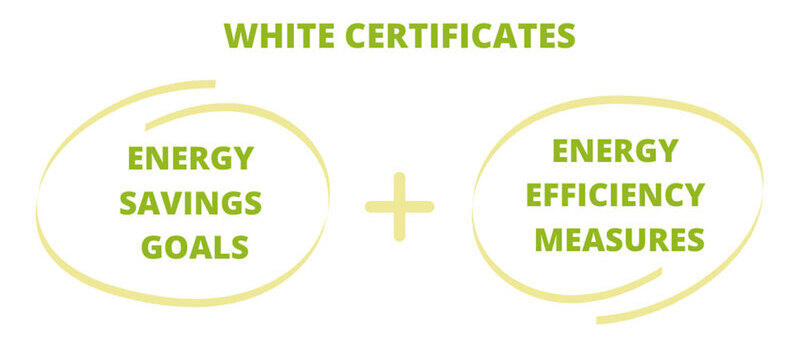
It is possible to increase energy savings by implementing a system based on negotiable certificates, also known as ‘white certificates.’ This mechanism combines an energy-saving goal for certain types of energy market operators, such as distributors, suppliers, and even consumers, with a system of auditing that verifies actual energy-efficiency measures. The savings are then verified by an independent third party and certified by white certificates.

To date, in Europe, the countries that have introduced similar market instruments to promote the reduction of energy consumption are Italy, France, and Poland.

The example of Italy

In Italy, Energy Efficiency Certificates, also known as White Certificates, have been implemented to reduce energy consumption. It is a market mechanism based on negotiable certificates that certify the achievement of savings in the final uses of energy through interventions and projects aiming at increasing energy efficiency. The certificates are issued by the competent authority on the basis of the realized energy savings. A certificate is equivalent to saving 1 ton of oil equivalent (toe), which is the unit of measurement commonly used in energy balances.

The obligated subjects are the electricity distributors and the natural gas distribution companies, to whom the savings objectives are set each year by means of specific decrees. To demonstrate that they have achieved these objectives and avoid incurring sanctions from the Authority, each year distributors must submit a number of ‘Energy Efficiency Certificates’ equivalent to their target.

The objectives are growing over time and can be achieved through the implementation of interventions with end consumers (i.e. installation of high-efficiency boilers, thermal insulation interventions of buildings, interventions to increase the energy efficiency in industrial processes, high efficiency light bulbs etc.), or through the purchase of Energy Efficiency Certificates. The certificates can be exchanged either  through bilateral contracts or through the organized market platform managed by the Gestore del Mercato Elettrico (the Electricity Market Operator).

A possible application in Switzerland

It is estimated that buildings in Switzerland consume about 40% of total energy, and are responsible for almost 1/3 of total CO2 emissions. The reduction of emissions in this sector is therefore relevant for the achievement of climate objectives, and the implementation of a national market mechanism could facilitate the process.

In our experience, such a mechanism could be inspired by those already existing in Italy and France, and take shape as follows.

Precise targets for reducing energy consumption should be defined at national level, and then allocated at cantonal level according to the regional performance of the buildings in terms of energy efficiency. The targets could be revised upwards every year, or every two years. The entities subject to the energy efficiency targets could be energy distribution companies, and / or cantonal and municipal authorities, and / or large energy consumers.

For the functioning of this mechanism it is essential to appoint a competent body, responsible for regulating and managing the issuance, transfer and cancellation of these certificates, which collaborates with the cantonal authorities for the purpose of verification.

The obliged parties will be entitled to achieve their objectives both through the implementation of energy efficiency measures and through the purchase of the corresponding amount of white certificates.A further incentive measure could include a minimum quota of certificates from energy saving projects carried out in the canton of residence of the obliged subject.

Each canton should create a fund, in which companies that do not meet their objectives would be required to pay a tax (expressed in CHF / tCO2). With the income from the fund, the canton could then finance additional projects to reduce energy consumption.


Continue reading